


The Human Problem: Wasteful Conversions
In a conventional home, AC (Alternating Current) power arrives at 110V or 220V. In an isolated (off-grid) solar system, the standard is to mimic this:
- Solar panels generate energy in Direct Current (DC).
- A controller stores this energy in batteries (DC).
- An Inverter converts the battery’s energy (DC) to AC (110/220V), 24 hours a day.
The problem is twofold:
- Conversion Loss: The DC-to-AC process is not 100% efficient. Energy is lost (as heat) in the inverter.
- Phantom Load: The inverter consumes energy just by being turned on, even if nothing in the house is being used.
- Double Loss: Most of our modern devices (LEDs, electronics) are DC. They take the 220V AC from the outlet and convert it back to DC (5V, 12V, 24V) in their chargers, wasting energy again.
The Idea (The Thesis): The Native 24V DC Architecture
This thesis proposes to flip the logic. Instead of AC power being the rule and DC the exception, 24V Direct Current becomes the backbone (the “busbar”) of the Ecological Rural House.
AC power (110/220V) becomes secondary, a convenience that is only activated (by turning on the inverter) when a specific appliance that truly requires AC is needed (like a blender, washing machine, or heavy tool).
The Universal Busbar: The Energy Meeting Point
The greatest benefit of this architecture is the simplicity of integrating multiple generation sources.
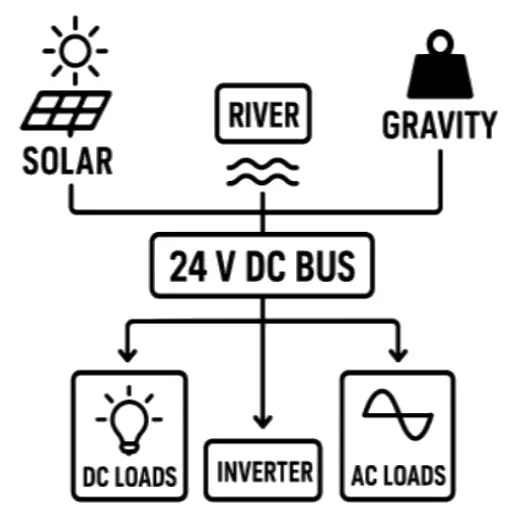
The 24V DC busbar (essentially, the terminals of the battery bank or capacitors) acts as an “energy lake” where all sources deposit their contribution:
- Solar Panels (Primary Generation):
- They are the main charging source. We use the initial sizing of 2 panels per resident (approx. 600-800Wp) as a starting point.
- A charge controller (preferably MPPT) manages the energy from the panels and delivers it to the 24V busbar.
- River Turbines (Base Generation):
- The turbines with scrap motors generate DC power (after rectification).
- This energy is injected directly into the 24V busbar, helping to maintain the charge overnight or on cloudy days.
- Gravity Towers (On-Demand Generation):
- When the energy towers are activated, the motors (acting as generators) produce DC power.
- This energy is also rectified and feeds the 24V busbar.
Why 24V and not 12V?
The choice of 24V (over 12V) is a technical engineering decision. For the same power, 24V requires half the current (Amperes) as 12V. This allows for the use of thinner wires (cables) for the same distances, reducing costs and energy losses in the house’s wiring.
The Inverter’s New Role: From King to Subject
In this architecture, the DC-to-AC inverter ceases to be the heart of the system. It is connected to the 24V busbar like any other appliance.
- 90% of the time: The inverter remains off, saving energy (zero phantom load).
- AC Appliance Use: When the resident needs to use a 220V tool or appliance, they switch the inverter on, use the device, and switch the inverter off when finished.
This drastically increases the system’s autonomy and efficiency, focusing the stored energy on what truly matters: light, communication (router), and refrigeration (DC water pump, DC refrigerator).
Part of the Ecological Rural House Ecosystem
This article defines the electrical architecture that unites all other generation and repurposing modules:
- [Storage]: Gravitational Energy Towers (Feeds the 24V busbar)
- [Generation]: River Turbines (Feeds the 24V busbar)
- [Repurposing]: Electric Car Scrap (The motors generate DC for the busbar)
- [Control]: The House Brain (Automation) (The Arduino/ESP32 that manages the 24V busbar)
“The cleanest energy is that which is not wasted in unnecessary conversions. Nature runs on DC; our home should too.” — Ideas Lab Reflection, engeAI.com
🔗 References
- DC Microgrids: Studies from the IEEE (Institute of Electrical and Electronics Engineers) on the superior efficiency of DC microgrids for homes and data centers compared to traditional AC systems.
- Off-Grid Inverter Efficiency: Technical analyses on “phantom load” (or no-load consumption) of inverters, which can consume 5W to 50W continuously.
- Low-Voltage Solar Systems: Manuals and best-practice guides for off-grid installations at 12V, 24V, and 48V, highlighting the advantages of 24V/48V for reducing wiring costs and resistive losses.
🔬 Technical Note Implementing a 24V DC grid requires specific components (bulbs, pumps, USB chargers, and refrigerators) designed to operate directly on this voltage. While common in the marine, RV (motorhome), and telecommunications markets, they may not be as easy to find in common retail as their AC (110/220V) counterparts. Correct sizing of DC cables and fuses is critical for safety.