



The Constant Flow of Opportunity: Riverine Energy
While the sun offers us energy during the day, perennial rivers and streams provide a constant energy flow, 24 hours a day, 7 days a week. For the “Ecological Rural House,” this continuous source is an ideal complement to intermittent solar energy, offering a robust and predictable generation base. However, building traditional micro-hydropower plants can be complex, expensive, and require significant civil works.
The Idea (The Thesis): The “River Raft” with an Automotive Heart
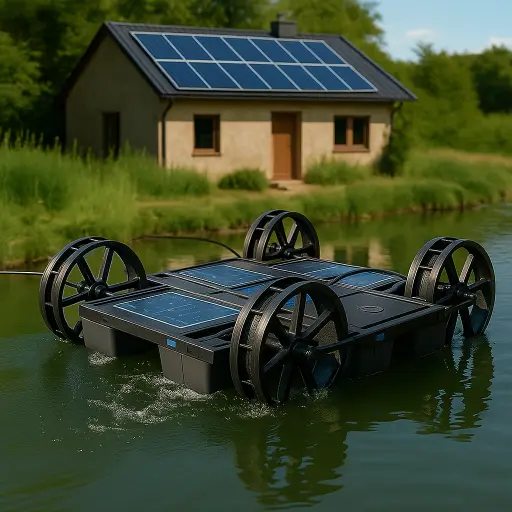
This thesis proposes a radically innovative approach to micro-hydropower generation, focusing on the intelligent repurposing of electric vehicle components and minimizing environmental impact. The central concept is a floating platform, anchored to the bank of a waterway, acting as a kinetic energy power plant.
The key insight is to use the chassis and motors of an end-of-life electric vehicle (EV), such as a BYD. These vehicles possess high-torque motors and high-capacity batteries that, even with some degradation for automotive use, are still perfectly functional for stationary or low-demand applications.
The System: Inverted BYD Chassis, Wheel-Blades, and Protected Motors
The system would consist of:
- The Floating Platform (“Raft”): Constructed from simple, local materials (wood, light metal structures) or using the EV chassis itself as a base. It would be securely anchored to the river/stream bank.
- The Generation Core (EV Chassis):
- The chassis of an electric car (e.g., BYD) is stripped of its bodywork.
- It is mounted inverted or adapted onto the platform, so that the four wheels (with axles) are submerged in the water.
- The original wheels would be equipped with hydrodynamic blades (e.g., plastic or metal paddles, optimized design) to capture the kinetic energy of the water flow.
- The Generators (Reversed EV Motors):
- The car’s original electric motors (which previously propelled the vehicle) are kept on their axles or adapted.
- They are positioned above the waterline, protected within watertight and ventilated enclosures on the platform.
- As the bladed wheels spin, driven by the water, they transmit movement to the axles, which in turn spin the electric motors. A mechanically spun electric motor acts as a generator, producing electricity.
- The Battery Buffer (Repurposed EV Battery):
- The original BYD (or other EV) battery, even with reduced capacity, is repurposed and installed on the platform, protected from the elements.
- It acts as a local energy buffer: it stores the energy generated by the motor-generators, smooths out current and voltage fluctuations, and ensures a stable flow of power before sending it to the Ecological Rural House.
- Its function is to stabilize generation and provide an energy “bridge,” not to be the primary long-term storage.
Benefits and Ecosystem Integration
- Constant Generation: Continuous power supply (24/7), complementing solar intermittency.
- Extreme Repurposing: Gives new life to EV components that would otherwise be discarded, reducing waste.
- Low Cost and Maintenance: Intelligently uses scrap. Motors above water simplify maintenance and protect against corrosion.
- Minimal Environmental Impact: Requires no dams or large civil works. The platform can be removed if necessary.
- Optimization of Main Storage: The EV battery-buffer reduces stress on the Gravitational Energy Towers , allowing them to focus on larger volume, long-term storage.
- 24V System Connectivity: The BYD battery can be configured to provide power at 24V (or multiples of 12V), easily integrating with other low-voltage components of the house.
Challenges and Rationale
Challenges lie in the engineering of the submerged blades (for maximum hydrodynamic efficiency), the robustness of the anchoring, and the control electronics to manage the output of the motor-generators and the battery buffer’s charge/discharge. The water flow rate of the river/stream is the limiting factor for generated power.
However, the principle is sound. The reverse engineering of automotive electric motors for power generation is a growing field, and its application in a micro-scale, low-impact riverine context is a promising solution for rural energy self-sufficiency.
Part of the Ecological Rural House Ecosystem
This thesis is a pillar of energy generation, directly connecting with:
- [Storage]: Gravitational Energy Towers: The Mechanical Battery (receives energy from the turbine)
- [Repurposing]: Using Electric Car Scrap and the ‘Positive Disposal’ Thesis (the central concept of repurposing)
“The passing river is a constant promise of energy, waiting for an idea to be harvested. Why not harvest it with what the future has discarded?” — Ideas Lab Reflection, engeAI.com
🔗 References
- Electric Vehicle Motors as Generators: Research on converting BLDC (Brushless DC) motors from electric vehicles into generators for small-scale applications.
- Small-Scale River Turbine Technologies: Reviews and studies on damless (“Run-of-river hydro-turbines”) Pico and Micro-Hydropower and their low-impact designs.
- Repurposing Electric Car Batteries (Second-Life Batteries): Numerous projects and companies explore the use of end-of-life EV batteries for stationary energy storage.
🔬 Technical Note The efficiency of the submerged blades and the choice of speed reducers (if necessary, depending on motor torque and current velocity) will be crucial. Protection against water debris and the security of the anchoring are fundamental engineering aspects to consider in detailed design. The BYD battery management system (BMS) will need to be adapted or replaced for stationary use.