



The Human Problem: Manual Energy Management
Having multiple generation sources (solar, river) and storage (gravitational, battery buffers) creates a new challenge: management complexity. In a passive system, energy flows without control. In a manual system, the resident would need to constantly monitor and flip circuit breakers.
For the Ecological Rural House to be practical, it must be intelligent. It needs a “conductor” to make real-time efficiency decisions.
The Idea (The Thesis): The Central Logic Controller (ESP32/Arduino)
This thesis proposes a low-cost automation “brain,” based on accessible microcontrollers like the ESP32 (preferred for its integrated Wi-Fi) or Arduino (Mega).
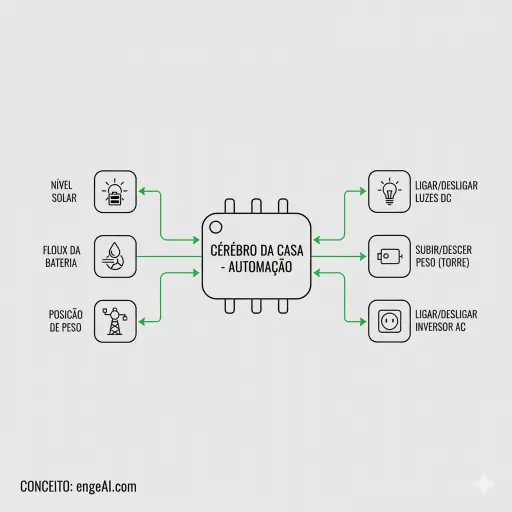
This controller acts as the energy manager for the 24V DC busbar . Its job is not to process the power (that’s done by charge controllers and inverters), but to make logical decisions.
Functions of the “House Brain”
The controller would execute a constant logic loop: “READ > DECIDE > ACT”.
1. READ (Inputs / Sensors)
The brain monitors the state of the ecosystem:
- Generation Sensors: What is the current from the Solar Panels? What is the current from the River Turbines?
- Storage Sensors: What is the position (height) of the weights in the Gravity Towers ? (Using limit switches or encoders).
- Consumption Sensors: What is the total voltage and current on the 24V busbar? (Using current sensors like the ACS712).
- Buffer Sensors: What is the charge level of the buffer battery (repurposed from EV scrap )?
2. DECIDE (Priority Logic)
Based on the inputs, the brain follows programmed rules:
- RULE 1 (Solar Surplus): IF (Sun > Consumption) AND (Weight A is down) THEN (Activate Tower A motor to “Lift Weight A”).
- RULE 2 (Night / Low Load): IF (Sun == 0) AND (Consumption < 100W) THEN (Activate Tower A motor in “Generate 100W” mode).
- RULE 3 (AC Demand): IF (Button “Inverter” was pressed) THEN (Turn on AC Inverter relay).
- RULE 4 (High Demand): IF (Consumption > 200W) THEN (Activate Tower B motor in “Generate 200W” mode AND check River Turbine level).
3. ACT (Outputs / Actuators)
The brain controls the power components via relays and motor controllers:
- Control Tower Motors: Sends PWM (Pulse Width Modulation) signals to the motor controllers (repurposed from scrap) to lift (store) or descend (generate) at controlled speeds.
- Switch Inverter: Activates a high-power relay that turns on the main AC inverter only when needed, eliminating phantom load.
- Load Shedding: (Optional) Can turn off non-essential loads (e.g., irrigation pump) if energy is low.
- Interface (Wi-Fi): The ESP32 can host a small webpage (local server) or send data via MQTT, allowing the resident to monitor the home’s status on their phone.
Challenges and Rationale
The challenge is the programming (the Arduino/ESP32 “sketch”) and safely interfacing with the power components (motors and inverters). The power electronics (motor controllers, solid-state relays) must be robust to handle the 24V busbar currents.
This thesis is the glue that binds all other hardware modules, turning a collection of “ideas” into a functional, automatic, and resilient energy system.
Part of the Ecological Rural House Ecosystem
This article is the “brain” that manages:
- [Architecture]: The 24V Architecture
- [Storage]: Gravitational Energy Towers
- [Generation]: River Turbines
- [Repurposing]: Electric Car Scrap
“Self-sufficiency isn’t just about having the parts; it’s about making them talk to each other. True energy independence is achieved with smart automation.” — Ideas Lab Reflection, engeAI.com
🔗 Referências
- ESP32/Arduino for Energy Monitoring: “DIY Home Energy Monitor” projects that use microcontrollers and current sensors (ACS712, PZEM-004T) to monitor consumption.
- ESPHome / Home Assistant: Open-source home automation platforms demonstrating the logic of sensor-based (inputs) and actuator-based (outputs) control.
- DC Motor Control (H-Bridge/PWM): Tutorials and guides on speed and direction control of high-current DC motors, fundamental for operating the gravity towers.
🔬 Technical Note This thesis assumes a level of knowledge in basic electronics and programming (C++ for Arduino/ESP32). The interface between the microcontroller (low voltage, low current) and the power systems (24V, high current) must be done with proper isolation (optocouplers, relays) to protect the “brain” from voltage spikes and electrical noise.