



The Human Problem: Chemical Dependency
For any isolated off-grid rural dwelling, the “Achilles’ heel” of solar power is storage. The standard solution – battery banks (whether lead-acid or lithium-ion) – suffers from several chronic issues:
- High Cost: They are the most expensive component of an off-grid solar system.
- Limited Lifespan: They have a finite number of charge/discharge cycles (typically 5-15 years for lithium, much less for lead-acid).
- Degradation: They lose efficiency over time and are sensitive to extreme temperatures (a problem in many climates).
- Maintenance and Risk: They require complex electronic management (BMS) and pose chemical and fire risks.
The Idea (The Thesis): The Mechanical Gravitational Battery
This thesis proposes replacing chemical storage with micro-scale gravitational potential energy storage. The concept is simple and based on fundamental physics ($E_p = mgh$ – Potential energy equals mass times gravity times height).
Surplus electrical energy from solar panels is used to perform mechanical work: lifting a large mass (weight) to a certain height. This energy is stored indefinitely (no self-discharge) as long as the weight is suspended. When electricity is needed, the weight is released to descend in a controlled manner, converting potential energy into kinetic energy, which in turn drives a generator.
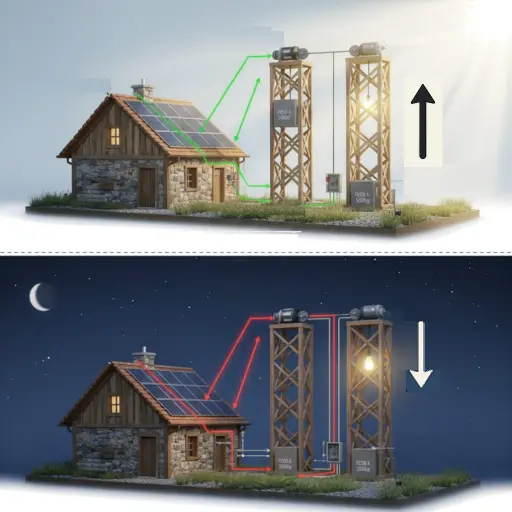
The System: Dual Towers with Reversible Motors
For the “Ecological Rural House,” the system would consist of:
- The Charging Source: Solar panels (or another renewable source, like river turbines ).
- The Lift/Generation Mechanism: High-torque electric motors (ideal for repurposing from electric car scrap), which operate reversibly (as a motor to lift the weight and as a generator on descent).
- The Structure: Two towers (wood, metal truss) with 6 to 8 meters of usable height.
- The Mass (The Storage): 300kg to 500kg weights (concrete blocks, scrap metal, sand-filled tanks).
- The Control: A simple controller (like an Arduino or ESP32) to manage the motors, descent speed, and power logic.
The Intelligent Dual-Tower Logic
As we discussed, Helder, using two towers allows for dynamic and intelligent power management without the need for complex power electronics:
- Storage (Solar Surplus): Both weights are lifted (independently or together).
- Low Power (e.g., night, 2 lamps + router): Only Weight A descends slowly, generating (e.g., 100W continuous).
- High Power (e.g., TV + desktop + 5 lamps): Weight A and Weight B descend simultaneously, doubling the power output (e.g., 200W continuous).
- Regenerative Mode (Optional): In theory, a descending weight could use part of its energy to help lift the other, optimizing the cycle.
- Minimal UPS: A small battery bank (perhaps also from automotive scrap) would be used only to power the controller and smooth the transition between sources, not for primary energy storage.
Challenges and Rationale
The power output is directly proportional to the mass and the speed of descent ($P = mgv$). To generate 1kW (1000W), one would need to lower a 500kg weight at a speed of approximately 0.2 m/s (or 12 meters per minute). This is mechanically feasible.
The biggest challenge is not the physics, but the mechanical engineering: efficient speed reducers, fail-safe braking systems, and cycle efficiency (losses in motor/generator conversion).
While companies like Energy Vault and Gravitricity apply this concept on a large (grid) scale, the innovation here is the micro-scale, rural application, using local materials and repurposed technology, focusing on durability over decades rather than the high energy density of chemical batteries.
Part of the Ecological Rural House Ecosystem
This thesis is the storage core of the project, connecting directly with:
- [Generation]: Solar Panels and Inverters
- [Generation]: River Turbines with Repurposed Motors
- [Repurposing]: Using Electric Car Scrap
“Why depend on volatile chemistry when we can rely on constant gravity?” — Ideas Lab Reflection, engeAI.com
🔗 References
- Large-Scale Concept (Grid-Scale): The technology from the Swiss company Energy Vault, which uses cranes and concrete blocks, validates the physical principle of large-scale gravitational storage.
- Shaft-Based Concept: The company Gravitricity, which proposes using disused mine shafts to lift and drop weights, demonstrating the feasibility of $mgh$-based power generation.
- Micro-Scale Applications: Academic studies on “Micro-scale gravity energy storage” for off-grid communities (e.g., WIPO Green Technology Book, MDPI “Storage Gravitational Energy for Small Scale… Applications”) that analyze the technical and economic feasibility of smaller systems, confirming efficiencies and long lifespans (50 years) compared to batteries.
🔬 Technical Note This is a conceptual engineering thesis. Although based on proven physical principles and validated at a large scale by several companies, the micro-scale rural implementation using repurposed materials (like electric car motors) requires detailed mechanical and electrical engineering design, careful prototyping, and rigorous safety testing, especially for the transmission, reduction gear, and braking systems.