



The Human Problem: High-Tech Waste
The transition to electric vehicles (EVs) is accelerating. With it, a new wave of technological waste approaches: degraded batteries, end-of-life vehicles (ELVs), and components from collisions. The conventional view treats this as a complex and expensive recycling problem. For the Ecological Rural House, which needs robust and efficient components, buying everything new is financially prohibitive.
The Idea (The Thesis): The Hidden “Infrastructure Kit”
The “Positive Disposal” thesis proposes that EV scrap (from a BYD, Nissan Leaf, or similar) is not waste, but rather a component hub perfectly suited for off-grid self-sufficiency.
An EV is essentially a high-efficiency mobile power system. By disassembling it, we obtain a “starter kit” for our home.
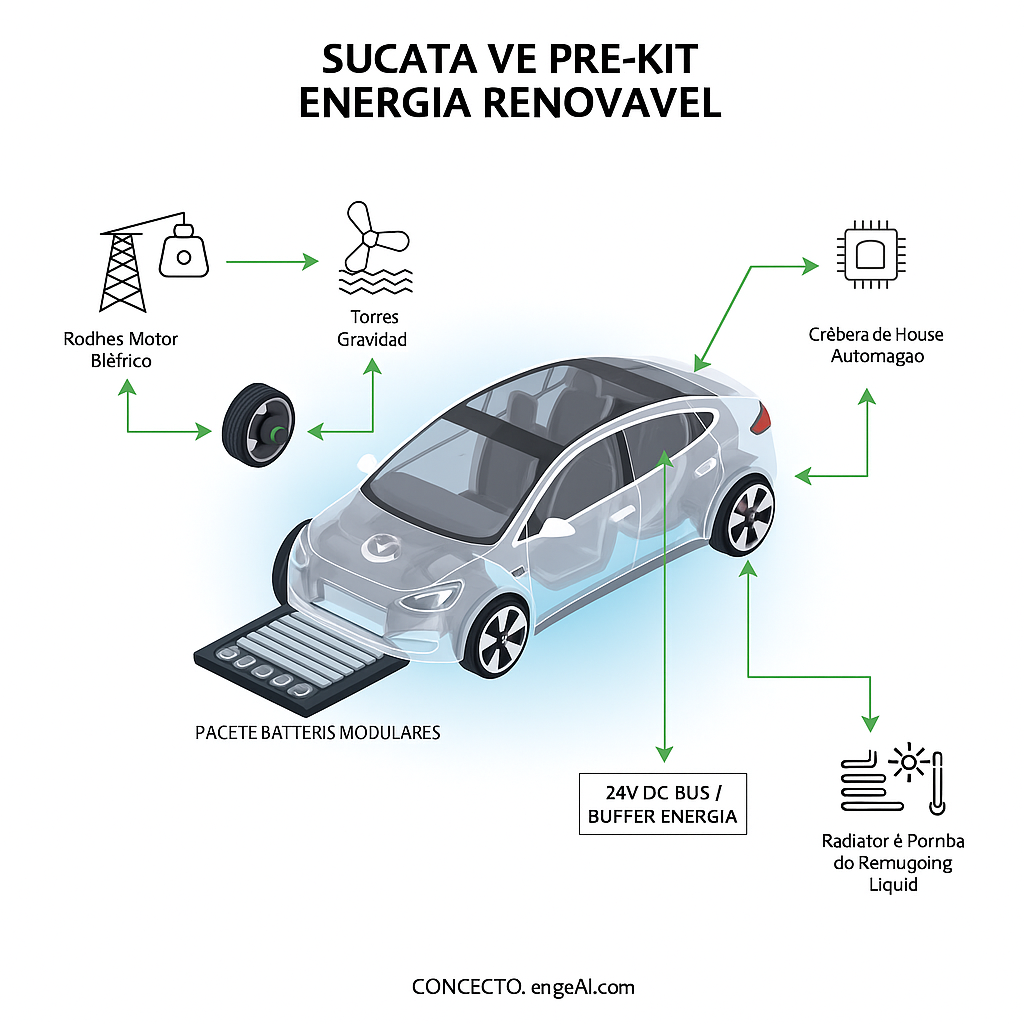
Key Repurposing Components
This article serves as the conceptual “hub” that connects the parts to their new functions:
Electric Motors (Traction or Wheel)
- What they are: High-power, high-torque permanent magnet or induction motors, sealed and robust.
- New Use: Used in reverse as Generators.
- Where they go:
- Gravitational Energy Towers (The motor lifts the weight, and the weight spins the motor to generate power).
- River Turbines (Water spins the motor’s shaft, generating power).
Lithium Battery Pack (Second-Life)
- What they are: High-density battery modules. Even “degraded” (e.g., 70% original capacity), they are superior to new lead-acid batteries.
- New Use: Stationary storage.
- Where they go:
- Energy Buffer: On the River Raft , to stabilize generation.
- Minimal Battery Bank: Connected to the 24V Busbar of the house, acting as the “UPS” that allows the tower system to function.
Controllers, Inverters, and BMS
- What they are: The power electronics that manage the motor and battery in the car.
- New Use: With reprogramming (hacking) or adaptation.
- Where they go:
- Can be the basis for the House Brain , controlling generator speed or managing the “second-life” battery charge.
Liquid Cooling System (Radiators, Pumps)
- What they are: Small radiators and 12V pumps used to keep the battery at an ideal temperature.
- New Use: Heat exchange.
- Where they go: Can be adapted for the Solar Water Heater system or for equipment cooling.
Challenges and Rationale
The biggest challenge is adaptation and control. Automotive motors are designed for efficiency at certain RPMs, and using them as generators requires good engineering (gear reducers, rectification electronics). Managing “second-life” lithium batteries (BMS) is crucial for safety and longevity.
However, the economic feasibility of giving these components a second life is immense, turning an environmental liability into an infrastructure asset.
Part of the Ecological Rural House Ecosystem
This article is the “raw material source” for:
- [Storage]: Gravitational Energy Towers
- [Generation]: River Turbines
- [Architecture]: The 24V Architecture
- [Control]: The House Brain (Automation)
“The end of the road for a car doesn’t have to be the end of the line for its technology.” — Ideas Lab Reflection, engeAI.com
🔗 References
- Second-Life EV Batteries: Numerous studies (Ex: NREL, Fraunhofer Institute) on the feasibility of EV batteries for grid storage and off-grid applications, confirming capacity retention.
- Repurposing EV Motors: “EV conversion” and “DIY electric tractor” communities documenting the process of hacking and reusing EV motors (like the Nissan Leaf’s) for new purposes.
- Circular Economy in Electric Vehicles: Reports on the end-of-life value chain for EVs, highlighting component repurposing as a key strategy.
🔬 Technical Note Reusing high-voltage components from EVs (motors and batteries) involves significant risks of electric shock and fire. This thesis assumes that disassembly and adaptation are performed by qualified personnel with knowledge of power electronics and safety protocols for lithium batteries (BMS).