



The Human Problem: The Pain of Not Feeling
The pain of living with diabetes is not always the pain one feels—it’s the pain of not feeling anything anymore. When peripheral nerves fall silent, the body loses its ability to react. A stone in the shoe, a fold in the sock, a small cut. All of this, for someone who has lost sensitivity, can be the beginning of a tragedy.
Amputation cases often start this way: almost imperceptible friction, a small blister that turns into an ulcer. And because there is no pain, there is no warning. The patient keeps walking. Days later, infection sets in—and the damage, which could have been avoided with a simple warning, becomes irreversible.
What’s Already on the Horizon
Medicine has advanced significantly in continuous glucose monitors, but plantar pressure monitoring is still an open field. Significant research exists on sensorized insoles and conductive fabrics. Some prototypes use braided carbon fibers and conductive filaments that detect micro-variations in pressure and temperature. Others study the use of AI to detect anomalies in gait patterns—early signs of injury risk. But nothing yet provides an accessible and comfortable solution for daily life.
Our Idea: The Smart Sensor Sock/Insole
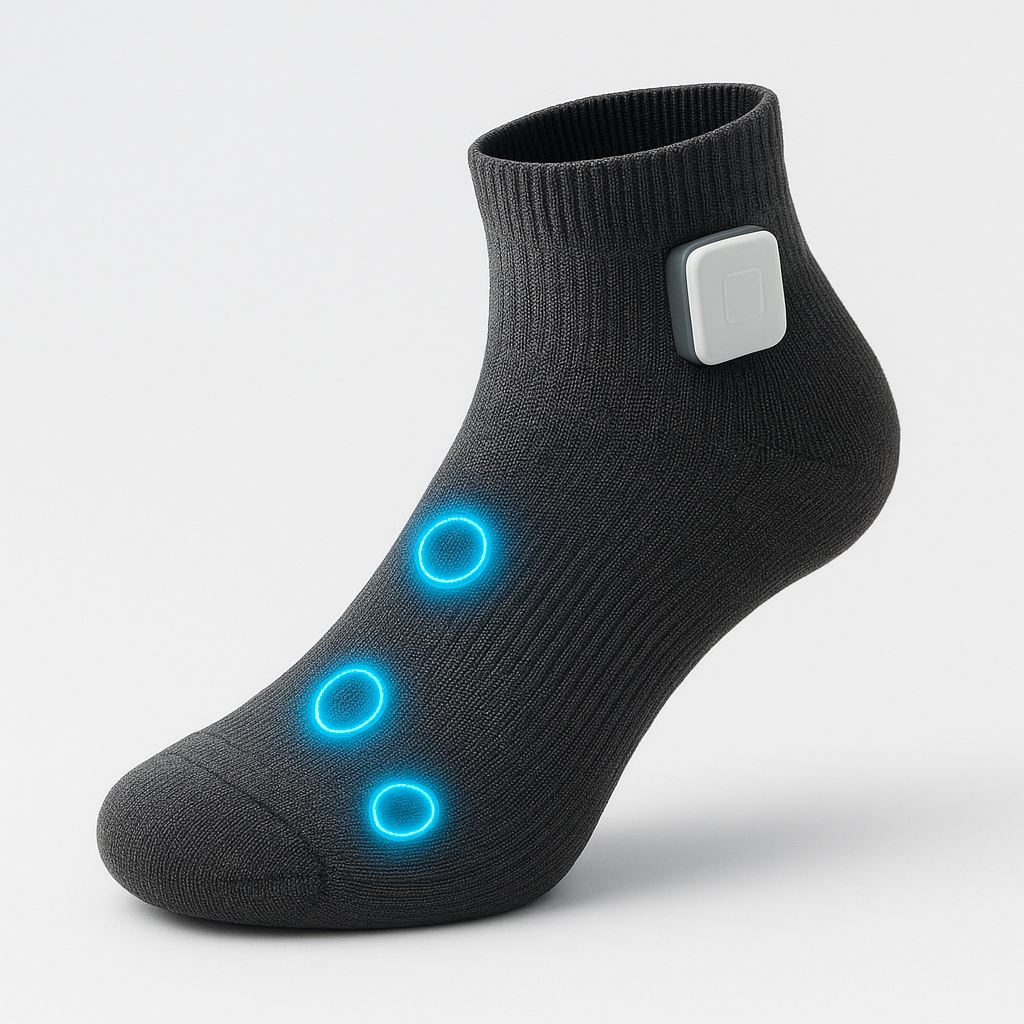
The proposal from our Lab of Ideas is simple and bold: create a wearable (either a sock or insole) capable of sensing what the body no longer can. Made with conductive microfibers and integrated sensors (pressure, temperature, humidity), connected to a mobile app or a central system like the AIA - Guardian of Lives, the device would function as an artificial sensory extension.
The AI, fed by continuous data, would learn the normal patterns for each user and alert in case of anomaly:
- Localized temperature increase: possible inflammation or infection.
- Irregular pressure: stone in shoe, foreign object, deformity, or developing callus.
- Excessive moisture: risk of maceration, fungal infection, or open wound.
The alert could come as a vibration in the device itself, a notification on the phone, or even a signal sent to the doctor/caregiver. The goal is to give the body back its warning voice—a new kind of digital sensitivity.
Challenges and Possible Paths
Like any innovation crossing the boundary between body and machine, there are real challenges:
- Power: How to power the system without compromising comfort? (Flexible batteries, wireless charging?)
- Reliability: How to calibrate sensors and AI to avoid false positives/negatives?
- Usability and Adoption: How to make the device comfortable, washable, and easy to use, especially for the elderly?
- Cost: How to make the technology accessible?
But the potential benefits far outweigh the obstacles. The cost of such a system would be a fraction of the hospital cost of an amputation. More importantly, it would restore safety, dignity, and autonomy to millions.
The smart sock/insole is more than a technical project: it’s a conversation about proactive care. It’s a reminder that technology can exist to feel with us, not just for us.
Part of the AI Care Ecosystem
This thesis on passive prevention represents the [Prevent] stage within our AI Care Ecosystem, complementing the stages of:
- [Diagnose]: The Caregiver’s Scanner
- [Restore]: Neural Interfaces and Smart Garments
- [Heal]: The Rapha Device (Context) / The Multiphase Therapeutic Boot (Thesis)
- [Integrate]: Living Technology: The Intelligent Fabric
“True healing begins when someone decides to feel another’s pain as their own.” — Lab of Ideas Reflection, engeAI.com
🔬 Technical Note This article is a conceptual proposal aimed at research and biomedical innovation. It does not represent an existing product but a thesis open for exploration by scientists, engineers, and entrepreneurs committed to preventive health and human well-being.