



The Human Problem: Interrupted Communication
A spinal cord injury, a stroke, certain advanced peripheral neuropathies, or neurodegenerative diseases can drastically interrupt the communication pathway between the brain and muscles. The consequence is paralysis or severe loss of motor function. However, the intention to move, the brain activity associated with the motor command, often remains intact. The “command” is generated but cannot reach its destination or be executed correctly. Traditional rehabilitation seeks to strengthen remaining neural connections, but in cases of complete interruption, the challenge is to create a new “bridge.”
The Technological Horizon: Reading and Writing Signals
Modern neuroengineering is advancing on two complementary fronts that form the basis of this thesis:
- Neural Reading (Input): Brain-Computer Interfaces (BCIs) and peripheral neural interfaces (including those focused on the spinal cord) use electrodes (implanted or surface) to capture the electrical activity associated with motor intent. Decoding these complex and noisy signals into clear commands (“move arm forward,” “flex knee”) is an immense computational challenge where Artificial Intelligence (especially neural networks and machine learning) plays a fundamental role. Research like the BrainGate project has already demonstrated the feasibility of controlling cursors or robotic arms with brain signals.
- Muscular Writing (Output): Functional Electrical Stimulation (FES) is an established technique that uses low-intensity electrical current to induce contraction in paralyzed muscles. Applied via electrodes on the skin or implanted, FES can generate functional movements (like pedaling an ergometer, grasping an object, or even assisting gait). Recently, research in smart textiles (e-textiles) has allowed the integration of electrodes and conductive wiring directly into clothing, potentially making FES application more practical, comfortable, and discreet.
The Idea (The Thesis): AI Orchestrating the Wearable Neuro-Muscular Bridge
Our thesis proposes the synergistic integration of these technologies:
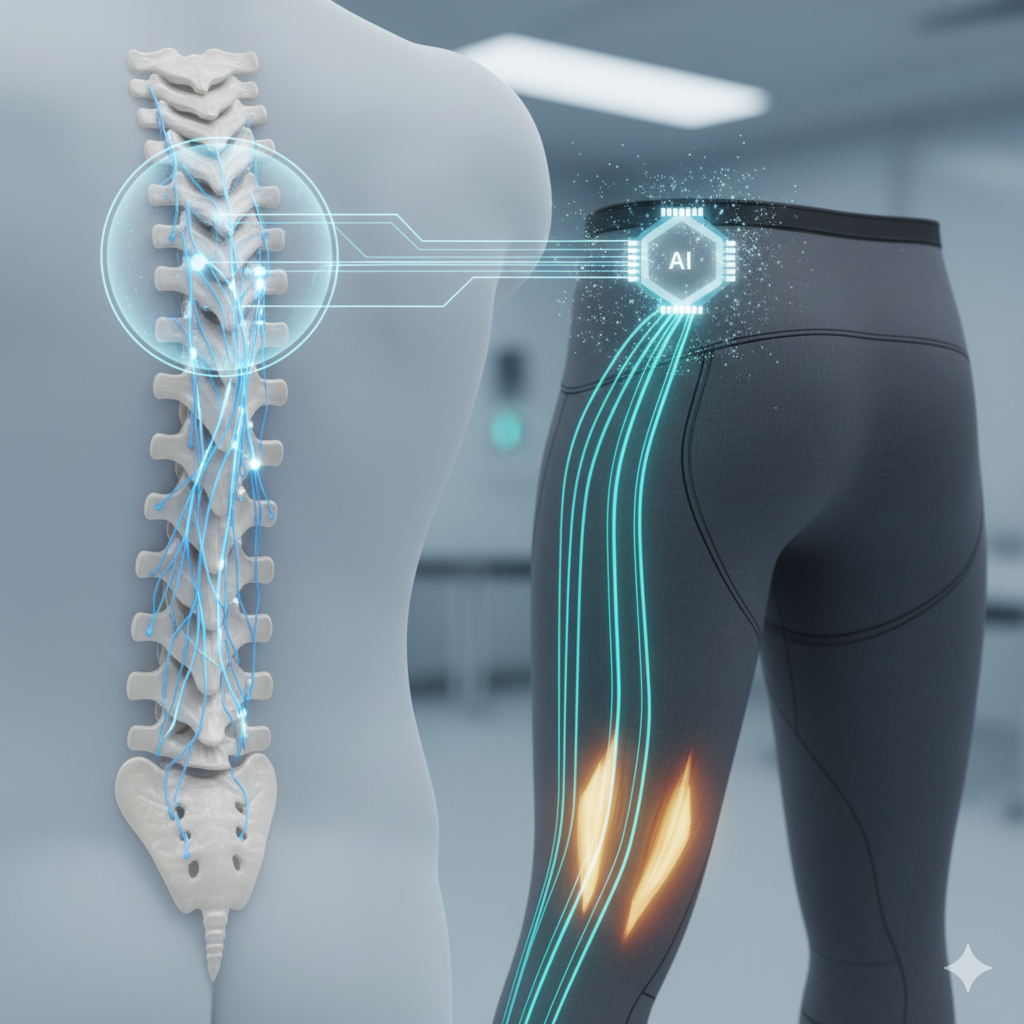
- A neural interface (preferably minimally invasive, perhaps capturing signals from the spinal cord or remaining peripheral nerves, or a non-invasive BCI) detects the intention to move.
- A decoding AI, possibly running on a portable processor or even a smartphone, translates these neural signals into muscle activation patterns.
- A smart garment (pants, sleeve, glove) with integrated FES electrodes receives commands from the AI and applies precise electrical stimuli to the appropriate muscles, in the correct sequence and intensity to generate the desired movement.
- (Optional/Advanced): Motion sensors (IMUs) in the garment could provide real-time feedback to the AI, allowing for fine adjustments and more natural movement control, correcting trajectory or force.
The result would be a “wearable neuroprosthesis” system: the AI acting as an artificial spinal cord, reading the brain’s intention and writing the action onto the muscles via clothing.
Potential Applications and Challenges
Applications extend beyond restoring gait in spinal cord injury cases:
- Post-Stroke Rehabilitation: Assisting in the recovery of arm and hand movements.
- Neurodegenerative Diseases: Maintaining motor function longer in patients with ALS or multiple sclerosis.
- Severe Diabetic Neuropathy: Stimulating foot and leg muscles to improve circulation and prevent atrophy (connecting to the Smart Sock/Insole idea).
- Physiotherapy: Guiding and assisting therapeutic exercises more precisely.
The challenges are enormous:
- Neural Interfaces: Accuracy, long-term stability, invasiveness (for implants), bandwidth for complex signals.
- AI Decoding: Correctly interpreting neural intent, adapting to each individual, minimizing latency (delay) between intent and action.
- FES and Garments: Precise control of muscle contraction, avoiding muscle fatigue, comfort and durability of textiles, power management.
- Ethics and Safety: Risks associated with implants, autonomous control versus user control, privacy of neural data.
The Ethical Path: Restore, Not Replace
As with all theses in our ecosystem, the purpose here is the restoration of function and dignity, not the creation of superhuman enhancements. Technology should serve as a bridge, an assistive tool, always respecting the person’s autonomy and integrity.
Part of the AI Care Ecosystem
This thesis on active restoration represents the [Restore] stage within our AI Care Ecosystem, connecting:
- [Prevent]: The Smart Sock/Insole
- [Diagnose]: The Caregiver’s Scanner
- [Heal]: The Rapha Device (Context) / The Multiphase Therapeutic Boot (Thesis)
- [Integrate]: Living Technology: The Intelligent Fabric
“The greatest barrier isn’t the missing technology, but the bridge we haven’t yet built between intention and action.” — Lab of Ideas Reflection, engeAI.com