



The Human Problem: Wounds That Defy Time
Chronic wounds, such as diabetic foot ulcers, represent an immense burden. They not only cause pain and limit mobility but also carry a constant risk of infection, potentially leading to amputation. The healing process in these cases is often compromised by multiple factors: poor circulation, neuropathy, persistent inflammation, bacterial infection, and a low-oxygen tissue environment (hypoxia). Current therapies aim to address these factors, but often in isolation or requiring complex and inaccessible hospital infrastructure.
The Idea (The Thesis): A Portable Therapeutic Ecosystem
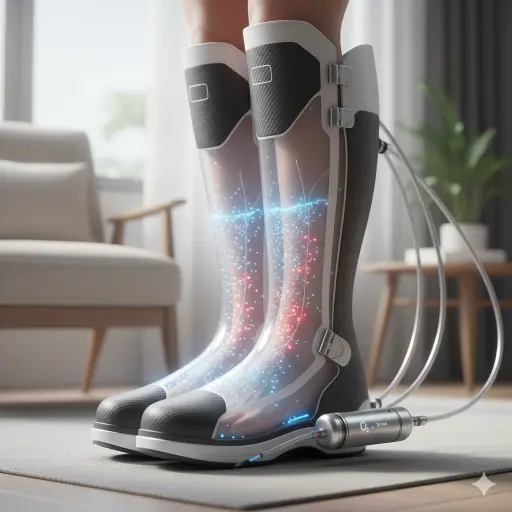
The Portable Multiphase Therapeutic Boot is a conceptual proposal aimed at integrating multiple proven (or promising) therapeutic approaches into a single wearable device for supervised home or outpatient use. The idea is to create a controlled microenvironment around the affected foot and leg, sequentially applying different stimuli to optimize healing.
Inspired by existing technologies and your suggestion, Helder, the boot could operate in programmable cycles managed by Artificial Intelligence:
- Preparation and Cleaning Phase:
- Initial Diagnosis (Optional): Integration with the Caregiver’s Scanner technology to map the initial wound condition (thermography, perfusion).
- Gentle Cleansing: Controlled application of ozonated water or another mild antiseptic solution for cleaning and reducing bacterial load. Ozone (O₃) has known antimicrobial properties.
- Oxygenation Phase:
- Localized Pressurized Oxygen: The boot would be sealed and filled with pure oxygen (from a portable cylinder or concentrator) under slight positive pressure (e.g., 1.3-1.5 atm). This would locally mimic the effect of Hyperbaric Oxygen Therapy (HBOT), increasing oxygen availability in the wound tissues to combat hypoxia and support cellular metabolism.
- Biostimulation Phase:
- Photobiomodulation (PBM): Activation of high-intensity LEDs (red and near-infrared) integrated into the boot to stimulate mitochondrial activity, ATP production, cell proliferation, and inflammation modulation.
- Controlled Heating: Maintenance of an optimal physiological temperature (e.g., 37°C) to favor enzymatic activity and vasodilation.
- Drainage and Vascular Stimulation Phase:
- Pulsatile Negative Pressure Therapy (Vacuum): Application of gentle, intermittent vacuum to remove exudate, reduce edema, and stimulate microcirculation and granulation tissue formation (similar mechanism to NPWT). Pulsation may act as “vascular training.”
- Additional Disinfection Phase (Optional):
- Controlled Gaseous Ozone: Brief exposure to gaseous ozone at a safe concentration for final disinfection of the wound surface and boot environment.
AI would be responsible for:
- Personalizing the sequence, duration, and intensity of each phase based on the initial diagnosis (from the integrated or manual scanner) and the wound type/stage.
- Monitoring tissue response in real-time via internal boot sensors (temperature, SpO₂, humidity, perhaps biomarkers in exudate).
- Dynamically adjusting the therapeutic protocol.
- Logging progress and generating reports for the healthcare professional.
- Ensuring safety, with multiple fault sensors (leakage, excess pressure/ozone).
The Technological Horizon and Rationale
This thesis combines existing or developing technologies: HBOT, ozone therapy, PBM (LED), NPWT, wearable sensors, and AI. The innovation lies in the multiphase integration, portability, and adaptive intelligent control. Advanced materials (biocompatible polymers, conductive textiles, microfluidics) would be required for construction. Miniaturization of ozone generators and oxygen concentrators is challenging but technologically plausible.
Integration with the AIA Ecosystem
The Therapeutic Boot would be a natural component of the AI Care Ecosystem. It would receive diagnostic data from the Caregiver’s Scanner , its use could be monitored by the AIA - Guardian of Lives (ensuring treatment adherence at home), and its progress data could feed the central AI for a holistic view of the patient’s health.
Challenges and the Ethical Path
The challenges are immense:
- Engineering: Integrating multiple systems (pressure, vacuum, gases, light, sensors, AI) into a safe, robust, portable, and affordable device.
- Safety: Strict control of ozone concentrations, pressures, temperature, and light doses to prevent harm.
- Clinical Validation: Proving the efficacy and safety of the combination and therapeutic cycles through rigorous clinical trials.
- Regulation: Obtaining approval from agencies like FDA/EMA for a complex medical device.
- Ethics: Ensuring supervised use (even if at home), correct data interpretation by AI, and maintaining human care as central.
The goal is not to replace the healthcare professional but to provide them with a powerful tool for intensive treatments outside the hospital setting, democratizing access to advanced wound healing therapies.
Part of the AI Care Ecosystem
This thesis on multiphase healing represents a vision for the [Heal - Thesis] stage within our AI Care Ecosystem, connecting with and complementing:
- [Prevent]: The Smart Sock/Insole
- [Diagnose]: The Caregiver’s Scanner
- [Restore]: Neural Interfaces and Smart Garments
- [Heal - Reality]: The Rapha Device (Context)
- [Integrate]: Living Technology: The Intelligent Fabric
“Healing is not just closing the wound, but restoring the flow of life in the dormant tissue.” — Lab of Ideas Reflection, engeAI.com
🔬 Technical Note This is a complex conceptual proposal combining multiple therapeutic technologies. It requires extensive research, development, and rigorous clinical validation before any practical consideration. It aims to inspire the search for integrated and accessible solutions for chronic wounds.