



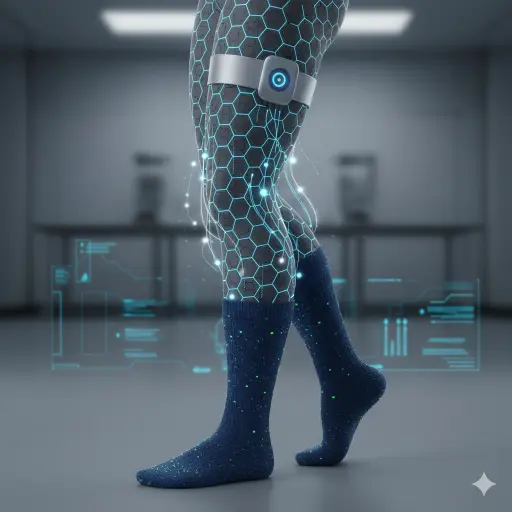
The Human Problem and the Technological Horizon
Spinal cord injuries, severe neuropathies, degenerative diseases – many conditions interrupt the vital communication between the brain and the body. The intention to move a limb exists, but the signal doesn’t arrive. Tactile sensation, which protects us and connects us to the world, disappears. In recent years, we’ve seen remarkable advances trying to bypass these barriers: exoskeletons assisting gait, brain-computer interfaces (BCIs) translating thoughts into digital commands, and advanced materials like graphene meshes capable of transmitting electrical signals at neural speeds.
But what if we could integrate these fronts into a single concept – a “technological skin” that functions as an extension of the nervous system?
The Idea (The Thesis): AI as a Neural and Textual Interpreter
We propose the vision of an “intelligent mesh” or “living fabric”: a garment (like a long sock, glove, or even a second skin) made of biocompatible conductive fibers (perhaps based on carbon or advanced polymers) and interwoven with microsensors (pressure, motion, maybe even bioelectric) distributed like artificial nerve endings.
This mesh would have two main functions, orchestrated by Artificial Intelligence:
- Read and Amplify: Sensors could pick up residual electrical signals from the spinal cord or peripheral nerves. The AI, trained individually, would learn to distinguish the intention of movement from background noise, amplifying only the relevant signal.
- Write and Stimulate: Based on the read signals (or other inputs), the AI could command electrical microstimulators (similar to FES technology) integrated into the mesh to contract specific muscles, aiding movement. More radically, it could generate patterns of tactile stimulation in body areas with preserved sensitivity, creating a new sensory pathway. Imagine a patient with no plantar sensitivity “feeling” the texture of the ground through coded vibrations on the thigh – a neural detour via AI.
The result would be a wearable system that learns the body, adapts to it, and responds like a living extension, a bidirectional interface between the nervous system and the external world. This concept originated from reflecting on the smart sock/insole for diabetics: if we can detect pressure to prevent, why not use similar technology to actively feel or respond?
The Ethical Challenge and the Path of Restoration
Any technology that integrates so intimately with the human body raises profound ethical questions. The line between restoring and “enhancing” can be thin. Therefore, the goal of this thesis in the Lab of Ideas is strictly focused on restoration and healing – returning lost functions, alleviating suffering, reconnecting the person to their own body and the world. The purpose is not to create superhumans or tools of control, but to use ingenuity to serve human dignity. The true frontier is not between man and machine, but between the responsible use and potential abuse of technology.
Part of the AI Care Ecosystem
This thesis on body-AI integration represents the [Integrate] stage within our AI Care Ecosystem, complementing the stages of:
- [Prevent]: The Smart Sock/Insole
- [Diagnose]: The Caregiver’s Scanner
- [Restore]: Neural Interfaces and Smart Garments
- [Heal]: The Rapha Device (Context) / The Multiphase Therapeutic Boot (Thesis)
“The skin is the first sense — perhaps the last that technology will learn to restore with true empathy.” — Lab of Ideas Reflection, engeAI.com