


The Human Problem: Care vs. Privacy
The aging population and the growing desire for autonomy in later life present a complex challenge: how to ensure the safety and well-being of the elderly or people with limitations, especially when living alone, without resorting to constant surveillance that erodes privacy and dignity? Security cameras, always-on microphones, and commercial virtual assistants collect vast amounts of data, often for purposes beyond direct care, generating distrust and the feeling of being under permanent observation. Care cannot become a domestic “Big Brother.”
The Inspiration: The Biblical “Aio” (Tutor)
Seeking an ethical model, we find inspiration in the biblical figure of the “aio” (Greek: paidagogos). The aio, in the Greco-Roman context and mentioned by Paul (Galatians 3:24), was not the main teacher but the trusted servant responsible for accompanying the child, protecting them on the way, ensuring their safety, and bringing them to the master. Their role was one of tutelage and guidance, marked by constant but discreet presence, zeal, and moral responsibility, without usurping parental authority or the student’s freedom.
The Idea (The Thesis): AIA - Intelligent Support Assistant
We propose AIA (Intelligent Support Assistant): a domestic AI system conceived under the ethical principle of the “aio.” Its exclusive purpose would be to support and protect, using technology in a non-invasive manner and focused on alerts of real need, preserving the individual’s privacy and autonomy as much as possible.
Fundamental Principles of AIA:
- Passive and Contextual Monitoring: Instead of continuous cameras and microphones, AIA would prioritize passive sensors:
- Environmental Sensors: Detection of smoke, carbon monoxide, gas, perhaps even alerts for a stove left on unattended.
- Thermal/Low-Power Radar Sensors: To detect falls, prolonged lack of movement in the bedroom at night, or significant changes in body temperature (fever), without generating recognizable images.
- Connectivity with Wearables: Integrate data from devices like the Smart Sock/Insole (temperature, plantar pressure, perhaps SpO2) or smartwatches (heart rate, fall detection).
- Local Processing (Edge AI): Primary data analysis would occur on the local AIA device within the home. Sensitive data (like movement patterns or vital signs) would not be sent to the cloud by default, only in case of an alert or with explicit consent.
- Anomaly-Focused AI: The AI would learn the individual’s and environment’s normal routines and patterns. The system would be designed to alert only on significant deviations indicating real risk (fall, fire, medical alert from the sock, lack of movement for an excessive and unusual period).
- Targeted and Proportional Alerting: Alerts would be sent only to pre-defined contacts (family, caregivers, emergency services), with relevant information for the necessary action, without sharing unnecessary history or data.
- No Human Surveillance: AIA would not be a tool to monitor the work of human caregivers (“snitching”). Its focus is the well-being of the assisted individual, based on objective sensor data, not interpretation of continuous images or audio.
Possible Forms of AIA:
AIA could manifest in different forms, depending on the desired level of interaction and assistance:
- Discreet Device: A small hub, resembling a router or a smart speaker without an always-on microphone, placed centrally in the home, collecting data from sensors.
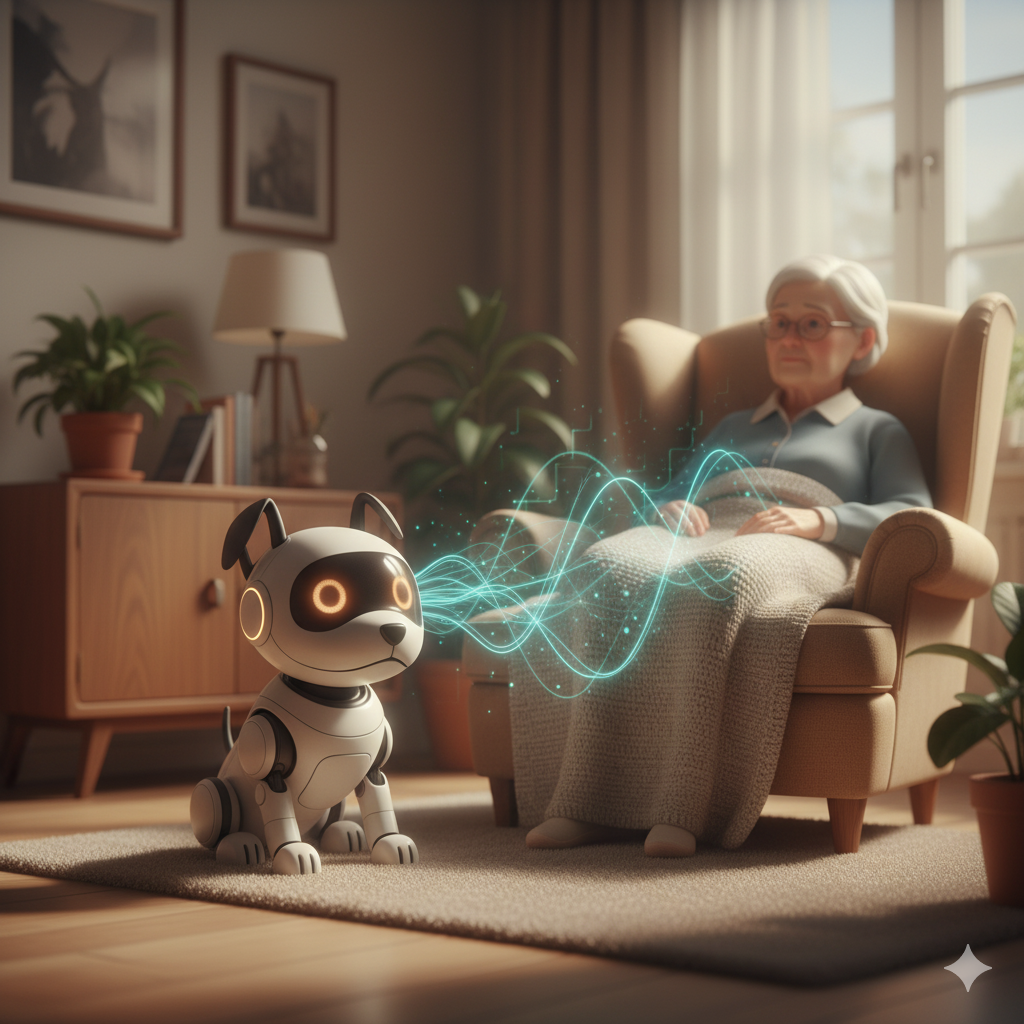
- Robotic Pet: A small companion robot (e.g., a robotic dog or cat), whose presence is friendly and less “technological.” Sensors would be integrated into it, and it could even interact simply (follow the owner, emit alert sounds). This form could combat loneliness in addition to monitoring.
- Assistant Humanoid (Distant Future): In a more futuristic vision, AIA could inhabit a humanoid robot capable of offering basic physical assistance (helping to stand up, fetching objects, perhaps even assisting with hygiene tasks like changing diapers for bedridden individuals), always under the same ethical principles of privacy and focus on essentials. This form raises much greater ethical and technical challenges.
The Central Ethical Challenge: Trust and Dignity
AIA’s success would critically depend on trust. The user and their family would need absolute assurance that the system exists to protect, not to spy or exploit data. Transparency about which sensors are active, how the AI works, and who receives alerts would be fundamental. The design—physical and software—should prioritize the feeling of safety and respect, not control. AIA must be perceived as a silent ally, a “guardian” in the noblest sense of the word.
Part of the AI Care Ecosystem
AIA functions as the [Ethical Hub] or central nervous system of our AI Care Ecosystem, integrating data and orchestrating alerts from the stages of:
- [Prevent]: The Smart Sock/Insole
- [Diagnose]: The Caregiver’s Scanner
- [Restore]: Neural Interfaces and Smart Garments
- [Integrate]: Living Technology: The Intelligent Fabric
“The most advanced technology is not the one that knows the most about us, but the one that best protects us without stripping our soul.” — Lab of Ideas Reflection, engeAI.com