



1. Introduction: The “Tyranny of Numbers”
In the early 1950s, electronics faced a paradox. The invention of the transistor promised a future of smaller devices, but a colossal obstacle stood in the way: the “tyranny of numbers.” A complex system required tens of thousands of individual components to be manufactured and then soldered by hand, a process that was expensive, slow, and prone to failure. The question was: how to build a complex circuit as if it were a single piece?
2. The Pioneer (Jack Kilby, Texas Instruments): The Proof of Possibility
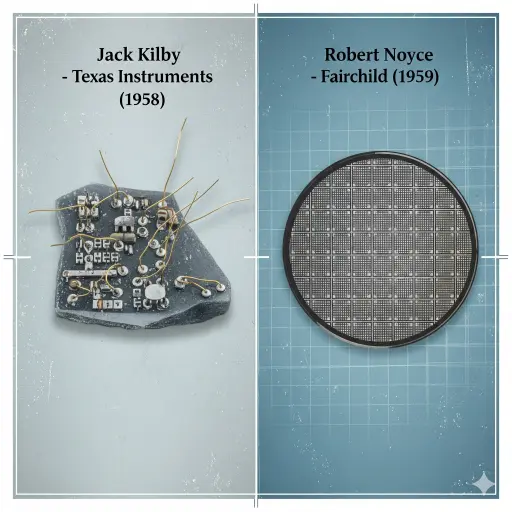
In 1958, engineer Jack Kilby of Texas Instruments demonstrated the first functional integrated circuit. It was a sliver of germanium with several components connected by fine gold wires. It was crude, but it worked, proving that the “tyranny of numbers” could be overcome.
3. The Visionary (Robert Noyce, Fairchild): The Proof of Practicability
Months later, Robert Noyce of Fairchild Semiconductor conceived a more elegant and, crucially, mass-manufacturable solution. Using the “planar process” on a silicon wafer, he integrated the components and “printed” the connections with aluminum directly onto a protective oxide layer. This was the blueprint that gave birth to Silicon Valley.
4. The Engineer’s Lesson: Innovation, Strategy, and the Power of Patents
The story of the chip teaches about the two faces of innovation: the proof of concept (Kilby) and scalable practicability (Noyce). But there is a third business lesson: the power of intellectual property.
Texas Instruments used its patent not to block competition, but to negotiate. In the late 1960s, Japanese companies needed the technology for the calculator market. After an intense commercial “cold war,” TI agreed to license its patent in exchange for the right to build its own factory in Japan. It was not a matter of disrespect, but a complex strategic trade where patents became the currency to conquer global markets, a lesson that shaped the tech industry forever.