


Introduction: The Weight of the Crown and the Invisible Code
The history of medicine is often the story of the fight against the invisible. For millennia, diseases like hemophilia were treated as curses or unalterable fates. Known as the “royal disease” for affecting Queen Victoria’s lineages and spreading through European courts (including the Russian, with the famous case of Tsarevich Alexei), hemophilia was a suspended death sentence. Blood, that vital force, refused to clot. A patient’s life was constant vigilance against the slightest trauma; internal bleeding could mean weeks of excruciating pain or premature death.
Treatment, for much of the 20th century, was rudimentary. It depended on whole blood transfusions or, later, plasma. It was crisis management, not a solution. And, as we tragically saw in the 80s, this dependence on human plasma opened the doors to a devastating crisis of HIV and Hepatitis C contamination.
Humanity desperately needed a way out. It needed to stop depending on nature and start dominating it. But how to dominate something we didn’t even fully understand? The secret was locked in the nucleus of our cells, written in a chemical language—DNA—that we only began to decipher in the second half of the 20th century.
The transformation of hemophilia from a death sentence to a curable disease didn’t happen due to a single “Eureka!” moment. It was a scientific marathon, a saga built on the shoulders of giants. It was the result of fundamental discoveries that were so revolutionary they redefined our understanding of biology and were recognized with science’s highest award: the Nobel Prize.
This is the story of how those discoveries left the laboratories of Stockholm and changed the lives of patients worldwide.
Chapter 1: The DNA Smiths (The 1980 Nobel)
To fix a machine, first, you need the right tools. Until the 1970s, DNA was seen as something almost sacred, a complex and untouchable structure. We knew it contained the instructions of life, but we had no way to manipulate it.
The paradigm shift began with the work of visionary scientists who realized that DNA was, deep down, a chemical molecule like any other—and, therefore, could be cut and pasted.
In 1980, the Nobel Prize in Chemistry was divided. Half went to Paul Berg, “for his fundamental studies of the biochemistry of nucleic acids, with particular regard to recombinant DNA.” The other half was shared by Walter Gilbert and Frederick Sanger, “for their contributions concerning the determination of base sequences in nucleic acids.”
Let’s translate this into our “coffee table talk”:
- Sanger and Gilbert gave us the ability to read. Before them, DNA was a closed book in a strange language. They developed the methods to “sequence” DNA, that is, read the exact order of the letters (A, C, T, G) that make up our genes. That was how, years later, we managed to find the exact “typing error” in the F8 gene that causes Hemophilia A.
- Paul Berg gave us the scissors and glue. He was the first to manage to take a piece of DNA from one organism (a virus) and connect it to the DNA of another completely different organism (a bacterium). He created the first recombinant DNA.
The Impact on Hemophilia: The Creation of Bio-Factories
This discovery was the cornerstone of everything that followed. If we could cut and paste DNA, then we could do something extraordinary: we could take the healthy human gene that contains the recipe for Factor VIII, cut it, and paste it inside the DNA of a cell from another animal—like the famous Chinese Hamster Ovary (CHO) cell.
The result was the creation of microscopic “bio-factories.” These hamster cells, now equipped with the human instruction, began to produce the Factor VIII protein in large quantities. It was no longer necessary to depend on the blood of thousands of human donors, with all its risks. The medication could be produced in the lab, pure, safe, and on an industrial scale.
In 1992, when the FDA approved the first recombinant Factor VIII (Kogenate), it was the direct application of knowledge awarded the 1980 Nobel that saved the hemophilia community from a new contamination crisis. It was the first time biological engineering rewrote the clinical fate of a disease.
Chapter 2: The Uncrowned Engineers (The AAV Revolution)
Recombinant DNA was a giant leap. It transformed hemophilia from a fatal disease into a manageable chronic one. But “manageable” still meant frequent intravenous infusions, damaged veins, and a life planned around medication. True freedom was still far away.
The dream of gene therapy was always to make the patient’s own body produce the missing protein. We already had the “recipe” (the F8 gene) and knew how to manipulate it thanks to the 1980 Nobel. The problem now was delivery. How to get that recipe inside the liver cells of a living patient, without the immune system destroying it?
The answer came from an unlikely area: virology. Viruses are the masters of genetic material delivery; they have evolved over millions of years to do just that—enter cells and hijack their machinery to replicate themselves.
The challenge was to transform a “villain” into a “postman.”
During the 1980s and 1990s, scientists like Jude Samulski, Xiao Xiao, and Richard Snyder dedicated their careers to studying a small and nearly harmless virus: the Adeno-Associated Virus (AAV). They learned to dismantle it, removing all its viral genetic material (the part that makes it replicate and cause any potential harm) and leaving only its protein “shell.”
This empty shell became the perfect vehicle. Scientists could then “stuff” it with the healthy copy of the F8 gene. When injected into the bloodstream, the AAV Vector travels to the liver, enters the cells, and releases its precious cargo into the nucleus. The liver cells then begin to read that new recipe and produce Factor VIII.
The Impact on Hemophilia: The Promise of the Functional Cure
This technology is the foundation of current gene therapies for hemophilia, such as Hemgenix (for Hemophilia B) and Roctavian (for Hemophilia A). With a single infusion, many patients manage to maintain protective clotting levels for years, freeing themselves from needles.
Although the pioneers of AAV technology have received important awards (such as the Lasker Award, often a precursor to the Nobel), they have not yet received the call from Stockholm. However, their work is a brilliant example of applied biological engineering that is changing lives today. It is the vital bridge between the basic science of the 80s and the medicine of the future.
Chapter 3: The Ultimate Scissors (The 2020 Nobel and CRISPR)
AAV therapies are a modern miracle, but they have limitations. They work by “addition”: they place a new gene working alongside the defective gene. The original gene with the error remains there. Furthermore, the effect may decrease over the years as liver cells renew themselves.
The final frontier of medicine was always true correction: going to the exact location of the error in the patient’s DNA and correcting it, like someone correcting a spelling error in a Word document.
This seemed like a distant dream until the discovery of CRISPR-Cas9. What started as a curiosity about how bacteria defend themselves from viruses transformed into the most powerful biological tool ever discovered.
In 2020, the Nobel Prize in Chemistry was awarded to Emmanuelle Charpentier and Jennifer Doudna “for the development of a method for genome editing.”
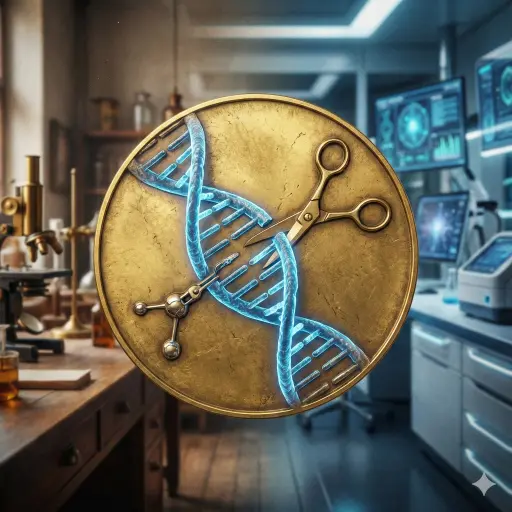
If the 1980 Nobel gave us rudimentary scissors and glue, the 2020 Nobel gave us a high-precision editing system with an integrated GPS. The CRISPR system uses a guide RNA molecule (the GPS) to take the Cas9 enzyme (the scissors) to an exact DNA sequence. Cas9 makes the cut, and the cell is then instructed to repair that cut using a correct gene template.
The Impact on Hemophilia: The Hope of the Permanent Cure
CRISPR brings the promise of a cure that is, for the first time, definitive. By correcting the error in the chromosome itself, the correction is permanent and will be passed on to all daughter cells when the liver cell divides.
Clinical trials, such as those conducted by Intellia Therapeutics, are already testing this technology in vivo (inside the body) to treat genetic liver diseases, and hemophilia is one of the next logical targets. We are moving from the era of “therapy” to the era of “editing.”
Conclusion: Power and Stewardship
The saga of hemophilia, told through these Nobel Prizes, is an impressive demonstration of what humanity can achieve. In less than 50 years, we went from powerless observers of a devastating disease to engineers capable of rewriting the code that causes it.
Each Nobel represents a step on that ladder of knowledge. Berg, Gilbert, and Sanger gave us the alphabet. The AAV engineers gave us the delivery vehicle. Charpentier and Doudna gave us the power to rewrite history.
But this technical saga must always end with an ethical reflection. The power to edit life is perhaps the greatest power we have ever had in our hands. These awards are not just medals of achievement; they are reminders of the immense responsibility that comes with knowledge.
We are not the creators of the code, but we have become its editors. And the true test of our civilization will not only be our scientific ability to cure, but the wisdom and humility with which we will use these divine tools to serve life, without ever falling into the pride of thinking we dominate it.
The story of hemophilia is a beacon of hope, illuminated by human genius, guiding us toward a future where biology is no longer destiny, but a landscape that we can, with care and respect, help to cultivate.
➡️ Connection to the Technical Series
This historical saga provides the foundation for understanding the modern technologies we explored in our technical series on hemophilia.
Quick links in this series
- Article 1: The Coagulation Twins
- Article 2: Recombinant DNA (The Bio-Factory)
- Article 3: The ‘Viral Postman’ (Current Therapy)
- Article 4: Market Analysis (Million-Dollar Cures)
- Article 5: The Genetic ‘Scissors’ (CRISPR)
- Article 6: A Reflection on Stewardship and Humility
- You are here -> ⭐ Historical Bonus: The Nobel Saga Behind the Cure
- ⭐ Historical Bonus: The Nobel Saga Behind the Cure