



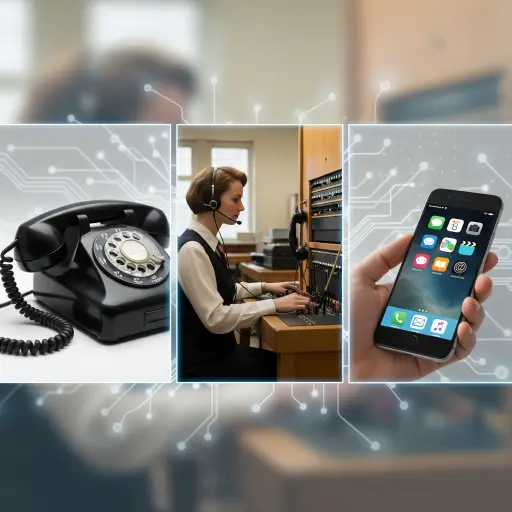
The phrase “having everything at your fingertips” is now synonymous with the speed of a touchscreen. But this phrase has a history, an engineering that began long before smartphones, with the physical effort and mechanical genius of technologies that now seem archaic. This is an analysis of the engineering behind the tools that taught us to connect.
1. Fingers on the Dial: Tactile Engineering
The rotary phone was not just a device; it was a purely mechanical human-machine interface.
- The Engineering: Each number corresponded to a precise rotation, which generated a series of electrical pulses. Dialing “7” sent seven pulses. It was a decimal coding system converted into electrical signals through springs and gears.
- The Experience: It required patience. A finger inserted into the hole, the rotation to the stop, the satisfying sound of the spring returning to its original position. It was a physical and deliberate interaction.
2. The Switchboard Operator: The First Human “Neural Network”
Before direct dialing, the connection was made by a human “CPU”: the switchboard operator.
- The Engineering: Telephone exchanges were complex switching panels. The operator was the “processor” who received a request (an “input”), found the correct destination, and created a physical connection, a “circuit,” by plugging a cable into a port.
- The Experience: It was a communication mediated by trust. You asked a person, and that person opened the path for your voice to reach another.
3. The Carbon Microphone: The Electrified Voice
Inside those old telephones, the magic of converting voice into electricity happened through a piece of engineering genius: the carbon microphone. Granules of carbon were compressed by the sound waves of your voice. The more compressed, the more electricity passed through, modulating the electric current to mimic your speech. It was the analog translation of the human voice.
4. Education by Menu: Learning to Read in DOS
Moving forward in time, my own home was the stage for one of these transitions. My son learned to read and write not with a tablet, but with a menu I created in MS-DOS on an old 286 computer. A simple autoexec.bat file launched an alphabetical menu. To play a game, he needed to find the right letter and press “Enter.”
- The Engineering: A simple
.batscript that listed programs in alphabetical order. - The Experience: He wasn’t just choosing a game; he was learning the fundamental interface of computational logic: command and execution. The need to find the right letter to get his reward (the game) was his first algorithm.
Conclusion: The Wisdom in the Tools
From the dial that required effort, to the operator who required trust, to the DOS menu that required logic, each stage of communication engineering taught us something. Today, we have everything in a touch, but it is the understanding of the path taken that gives us the wisdom to use today’s technology with discernment, and not just for convenience.