



1. The Limitation of Current Gene Therapy (AAV)
Our previous article (Article 3) explained AAV: the “postman” that delivers a copy of the F8 gene to liver cells. This “addition” strategy is effective and transformative, but it has limits:
- Durability: The added gene does not fully integrate into the chromosome; it floats in the cell nucleus (episome) and can degrade over time.
- Cure Potential: The body still contains the original defective F8 gene in its DNA; AAV therapy is a ‘workaround,’ not a ‘correction.’
The next goal in science is to achieve the permanent correction of the genetic error.
2. What is CRISPR/Cas9: The Molecular Scissors
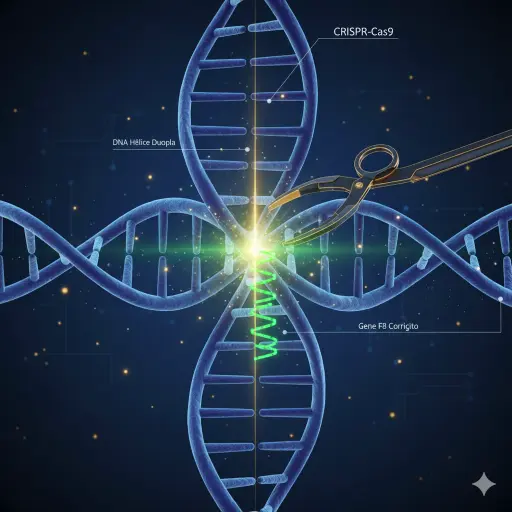
CRISPR (Clustered Regularly Interspaced Short Palindromic Repeats) and the associated enzyme Cas9 are, in essence, the most precise DNA editing system ever discovered.
Let’s imagine the coffee table conversation:
- The Scissors: Cas9 is the enzyme (the “scissors”) that can cut the DNA double helix at an exact location.
- The GPS: CRISPR is a guide molecule that functions like a GPS, pointing the Cas9 scissors to the precise cutting point. In the case of hemophilia, the target would be the F8 gene on the X chromosome.
- The Correction: After the cut, the cell’s natural repair mechanisms are activated. The scientist can then provide a correct DNA template, which the cell uses to “patch” the cut, thus correcting the genetic error.
3. CRISPR in Hemophilia: The Future of In Vivo Editing
The application of CRISPR in hemophilia is not just theoretical; it is actively in early-phase clinical trials, such as those conducted by Intellia Therapeutics (NTLA) 1.
The process is as follows:
- Packaging: The CRISPR/Cas9 system and the guide molecule are packaged in lipid nanoparticles (similar to some vaccines, but not in AAV viral vectors) or, in some cases, still using AAV vectors.
- Delivery to the Liver: The package is infused and delivered directly to the liver hepatocytes.
- Correction: Once inside the nucleus, the CRISPR system finds the defective F8 gene and corrects it.
The goal is to create a “permanent cure” that lasts the patient’s entire life, eliminating hemophilia at its root.
4. Safety, Risks, and the Ethical Question
Despite the promise, CRISPR poses challenges that are significantly greater than those of AAV therapies:
- Off-Target Effects: The greatest concern is “off-target cutting.” If the Cas9 scissors cut the DNA in a location other than the F8 gene, it could cause unintended and potentially dangerous mutations.
- Sovereignty of the Code: Because it involves a permanent alteration of the original genetic code, CRISPR is the most sensitive frontier of biotechnology. This leads us to the reflection we will undertake in our wisdom article.
Success in initial trials is promising, but science demands caution and rigorous follow-up before these “scissors” are widely used.
➡️ The Continuation of the Series
Science is giving us the power to correct the code of life. This ability, however, places an immense responsibility on our shoulders. What is the ethical limit?
Quick links in this series
- Article 1: The Coagulation Twins: The Story That Revealed the Error in the Code
- Article 2: Recombinant DNA: The ‘Bio-Factory’ That Brought Hope
- Article 3: The ‘Viral Postman’: The Real Technology Behind Gene Therapy
- Article 4: Hemgenix and Luxturna: An Analysis of Multi-Million Dollar Cures
- You are here -> The Next Frontier: Where CRISPR’s ‘Scissors’ Enter the Story
- Article 6: Correcting the Code of Life: A Reflection on Stewardship and Humility
- ⭐ Historical Bonus: The Nobel Saga Behind the Cure
🔗 References
The New England Journal of Medicine (NEJM). Clinical trial articles from Intellia Therapeutics on in vivo gene editing for Hemophilia. ↩︎