



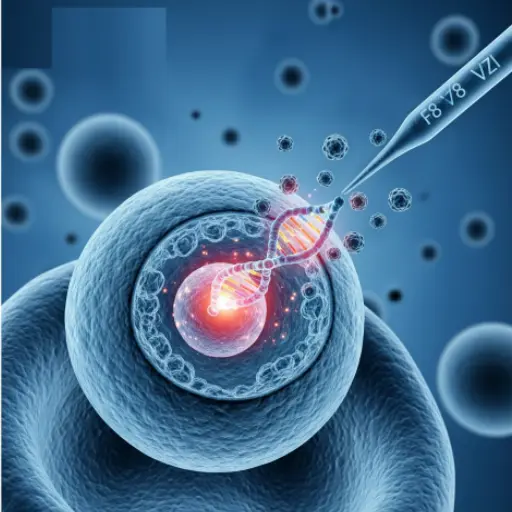
1. The Past and the Crisis: Plasma Treatment
In the 1970s and 1980s, hemophilia patients relied on plasma-derived Factor VIII concentrates to control bleeding. Although this was an improvement over whole blood transfusions, the source was still the blood of thousands of donors.
Unfortunately, the screening and sterilization methods of the time were insufficient to stop viral transmission. The result was a public health tragedy: thousands of patients worldwide were fatally infected with HIV and Hepatitis C through these treatments 12.
This crisis created an urgent demand from society and science: to find a Factor VIII source that was clean, safe, and completely independent of human blood.
2. The Revolution: Recombinant DNA and CHO Cells
The discovery of the human F8 gene in 1984, detailed in Article 1, opened up a new possibility: to produce Factor VIII in the lab. The concept is simple, but its execution was revolutionary:
- Isolate the “recipe”: The healthy F8 gene was isolated and used as the blueprint for protein production.
- Find the “factory”: Chinese Hamster Ovary (CHO) cells were chosen. They are robust, multiply quickly, and are excellent at producing complex proteins.
- Transfer the instruction: Molecular biology techniques allowed scientists to “paste” the human F8 gene inside the DNA of the CHO cells.
- Mass Cultivation: The modified CHO cells were placed in large bioreactors. They now followed the new genetic instruction and began producing pure human Factor VIII on a large scale.
These animal cells became the first bio-factories for modern medicines, capable of providing a stable therapeutic protein and, most importantly, free from human viral contamination.
3. The Impact: Safety and the End of an Epidemic
In 1992, the FDA (the U.S. regulatory agency) approved the first recombinant Factor VIII products, such as Kogenate and Recombinate 3.
For patients, this was a life-changer. For the first time, they could administer the missing protein with complete safety, eliminating the risk of viral infection from plasma.
The impact was profound: hemophilia moved from a condition marked by the constant risk of viral epidemics to a manageable chronic disease. This technology proved that when nature presents a risk, science can intervene and reprogram biological systems to create a solution.
4. Legacy of Applied Science
The development of recombinant DNA for Factor VIII is not just a medical milestone but a fundamental victory for biotechnology. It demonstrated how a meticulous understanding of human DNA can be transformed into tangible solutions that protect and save lives.
Today, this bio-factory technology continues to be the foundation for producing many medicines, and the concept it proved—using an organism to produce a therapeutic protein—paved the way for even more advanced therapies, which we will explore in our next article.
➡️ The Continuation of the Series
Safety was achieved. But medication still needs to be infused. The next challenge was: how to get the patient’s body to produce the protein itself?
Quick links in this series
- Article 1: The Coagulation Twins: The Story That Revealed the Error in the Code
- You are here -> Recombinant DNA: The ‘Bio-Factory’ That Brought Hope
- Article 3: The ‘Viral Postman’: The Real Technology Behind Gene Therapy
- Article 6: Correcting the Code of Life: A Reflection on Stewardship and Humility
- ⭐ Historical Bonus: The Nobel Saga Behind the Cure
🔗 References
PubMed – Hemophilia and plasma-derived products (1950–1992). https://pubmed.ncbi.nlm.nih.gov/38953434 ↩︎
NCBI – Hemophilia: Past and Present Treatments. https://www.ncbi.nlm.nih.gov/books/NBK551607 ↩︎
FDA (1992). “Approval of Kogenate (Bayer) and Recombinate (Baxter) for Hemophilia A”. FDA historical approvals database. ↩︎