



1. The Mystery of the “Not-So-Identical” Twins
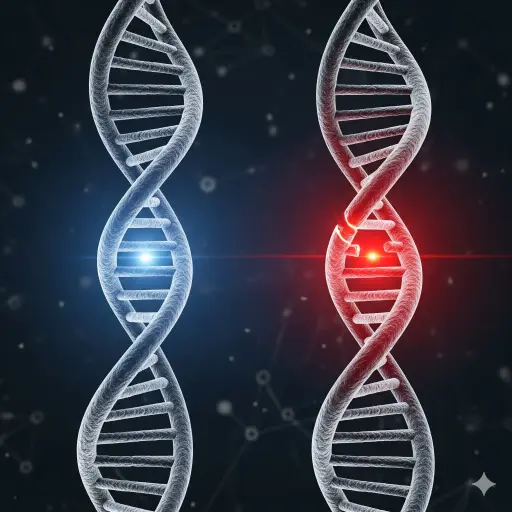
The story of the hemophilia treatment revolution begins in the 80s—not in a high-tech lab, but with an intriguing human case. Researchers in Europe were studying an extremely rare case: two identical twin brothers, but with a difference that changed everything. One suffered from hemophilia A; the other was perfectly healthy.
How was this possible? Being identical twins, their DNA should have been an exact copy. The difference between them could only mean one thing: a small, yet decisive, “typing error” in one of their genetic codes.
By comparing the two genomes, scientists were able to identify the cause: a mutation in the F8 gene, located on the X chromosome. This gene is responsible for instructing the body to produce Factor VIII, the essential clotting protein that allows blood to stop bleeding 1.
This discovery, born from observing two brothers, paved the way for everything that would follow. But before exploring the technology, we must answer the question that echoes most among families affected by hemophilia.
2. The Parents’ Question: Is It Inheritance or an “Error” in the DNA?
When a family receives a hemophilia diagnosis, the first question is almost always emotional: “Is it our fault? Is this inherited, or was it an error that just happened?”
The scientific answer is simple and compassionate: both are true. Hemophilia is a hereditary disease caused by a genetic mutation—a microscopic error that alters an essential instruction in the DNA.
Let’s imagine this conversation at a coffee table:
- What is Inheritance? Hemophilia is an X-linked disease.
[Image of X-linked recessive inheritance pattern]
The F8 gene (Hemophilia A) is on this chromosome, and so the transmission follows a peculiar logic:
A carrier mother (with one healthy X and one altered X) usually doesn’t show symptoms but has a 50% chance of passing the mutated X to each child.
If a son (XY) inherits that altered X, he will have hemophilia.
If a daughter (XX) inherits the altered X, she will be a carrier—like her mother.
A father with hemophilia (XY) will always pass his Y chromosome to his sons (who won’t have the disease) and his altered X to all his daughters (who will be carriers).
But what if there were never cases in the family? This is where the “error” comes in. The World Federation of Hemophilia (WFH) estimates that in about one-third of all cases, the disease is not inherited—it arises from a spontaneous mutation in the F8 gene, a random event that occurred at the moment of conception 2.
Therefore, hemophilia is no one’s fault. It is a genetic condition that can be inherited or appear for the first time in a new generation. And it was by understanding this origin that science could dream of something even bolder: not just treating the disease, but correcting the code itself.
➡️ The Continuation of the Series
The discovery of the F8 gene was the first step. In the following articles, we will explore how science turned that knowledge into action, from the first safe treatment sources to the gene therapy that is on the horizon today.
Quick links in this series
- You are here -> The Coagulation Twins
- Recombinant DNA: The ‘Bio-Factory’ That Brought Hope
- The ‘Viral Postman’: The Real Technology Behind Gene Therapy
- Correcting the Code of Life: A Reflection on Stewardship and Humility
- ⭐ Historical Bonus: The Nobel Saga Behind the Cure