



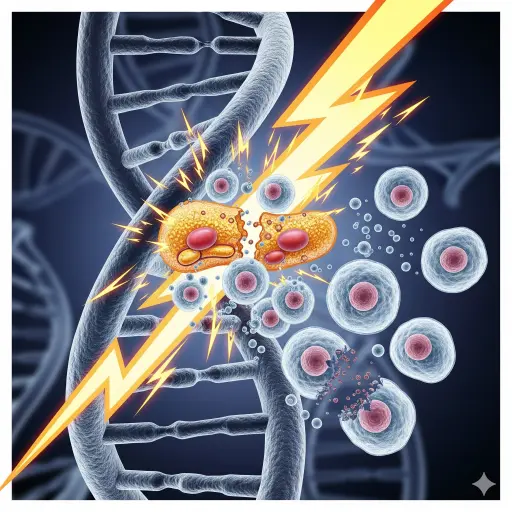
The Weapon and the Trigger: Stress, Genetics, and Hope in Type 1 Diabetes
If you are reading this, it’s likely because the term Type 1 Diabetes (T1D) has crossed your path. Perhaps as an unexpected diagnosis for your child. Perhaps as a shock to your own system.
And, in that moment, amidst insulin, glucose readings, and appointments, a question arises that echoes louder than all the others:
“Why?”
It’s a tough question, laden with pain and guilt. Many parents, deep down, even think:
“Was it a trauma, a stressful event, something that happened that I should have prevented?”
The short, clear, and liberating answer is: no. It’s not your fault.
And to understand this, we need a metaphor: that of the weapon and the trigger.
The Weapon: Genetic Predisposition
Your child was born with a genetic “map” that made them more susceptible to T1D.
It’s like having a loaded weapon, stored in a safe. The weapon exists, but it might remain locked away for a lifetime.
Studies with identical twins (who share 100% of their DNA) clearly show this: both do not always develop the disease.
In many studies, the clinical concordance between identical twins ranges from 20% to 40%1.
In other words: genetics matter, but they do not determine destiny.
The Trigger: Environmental Factors and the Role of Stress
If genetics is the weapon, something needs to pull the trigger.
And this is where environmental factors come in.
Science takes seriously the hypothesis that serious life events—such as emotional trauma or significant loss—can increase the risk.
A large-scale Swedish prospective population study followed thousands of children and showed that those who experienced a “serious life event” had a risk of developing T1D that was almost three times higher2.
It’s important to note: we’re talking about association, not absolute certainty.
Stress doesn’t “create” the disease on its own, but it can be the spark in an already predisposed terrain.
Cellular stress: when the factory asks to stop
Besides life events, stress also acts at the level of the beta cells.
Recent research has shown that stress hormones can impair beta cell function, involving molecular mechanisms like the riborepressor GAS5 LincRNA3.
Furthermore, it’s possible to modulate cellular stress pathways to protect stem-cell-derived islets from apoptosis, paving the way for genetically fortified cells that, in the future, could be implanted using techniques like the VX-8804.
It’s as if the small insulin factory is overloaded to the point of triggering an internal failure alarm.
These mechanisms help explain why stress can accelerate the path to autoimmunity.
The Disease Map: The 3 Stages of Type 1 Diabetes
Perhaps the most revolutionary information of recent years is this:
today we know that T1D doesn’t just start overnight.
It progresses in three well-defined stages, recognized by the international scientific community5.
- Stage 1: The person is asymptomatic, but tests already detect two or more autoantibodies. The silent war has begun.
- Stage 2: In addition to autoantibodies, slight changes in glucose metabolism (dysglycemia) begin. Still no symptoms.
- Stage 3: The classic symptoms appear (intense thirst, frequent urination, rapid weight loss). By now, there has been significant destruction of beta cells.
This model brings a new perspective: it’s not just about waiting for a diagnosis, but about monitoring and intervening earlier.
Hope: From Prediction to Intervention
Until a few years ago, it was only possible to act at Stage 3—when symptoms were already present.
But science has opened two new fronts:
- Prediction: It is now possible to screen for autoantibodies in relatives of people with T1D. Programs like TrialNet offer free testing in several countries6.
- Intervention: In 2022, the FDA approved the first drug capable of delaying the clinical onset of T1D: Teplizumab (Tzield)78.
Teplizumab is an immunotherapy that, in clinical trials, was able to delay the onset of Stage 3 by about 2 years, on average.
For a child, this can mean two more years without insulin.
It’s not a cure, but it is a historic breakthrough.
Future Horizons: Beyond Prediction and Immunotherapy
Teplizumab was a milestone, but science has not stopped there. The quest is to preserve or restore beta cell function.
Some prominent paths already being explored in our series include:
Lantidra: The first approved donor islet transplant for severe T1D. Read the analysis here →
VX-880: The experimental therapy using stem cells to create an unlimited supply of insulin-producing islets. Read the analysis here →
VX-264 (The ‘Invisible’ Cell): The frontier of research, using gene editing to make beta cells invisible to the immune system, opening the door for transplants without immunosuppression. Read the analysis here →
These lines of research reinforce that the fight against T1D is alive, full of hope, and with multiple fronts opening up for more effective and lasting interventions.
What to do with this knowledge?
If your child has already been diagnosed, it can be painful to think that “it could have been different.”
But that is not the intention of this information.
The true utility is twofold:
- Understanding. Knowing that T1D did not happen by chance, nor by your fault, but was the meeting of genetic predisposition and environmental factors.
- Mission. For family and friends of someone with T1D, the recommendation is no longer just to “wait.” It’s about talking to the pediatrician about autoantibody screening. It’s about sharing the information that strategies already exist to predict and even delay the disease.
A new way of seeing the future
Knowledge doesn’t change the past.
But it can change the future of another child.
Knowing that there is a “map” of the disease, that we can predict the stages, and that a first approved therapy already exists, transforms pain into wisdom and experience into hope.
And perhaps that is the most beautiful way to give meaning to your own journey:
to become a beacon for others.
References
Kaprio J, et al. “Concordance for Type 1 (insulin-dependent) and Type 2 (non-insulin-dependent) diabetes mellitus in a population-based cohort of twins in Finland.” Diabetologia. 1992;35(11):1060-7. ↩︎
Nygren M, et al. “Experience of a serious life event increases the risk for childhood type 1 diabetes: the ABIS population-based prospective cohort study.” Diabetologia. 2015;58(7):1456–1464. ↩︎
Chung HK, Son M, Choi YJ, et al. “Glucocorticoid induces human beta cell dysfunction by involving riborepressor GAS5 LincRNA.” FASEB J. 2020;34:15764–15778. PMC link ↩︎
Leite NC, Pelayo GC, Melton DA. “Genetic manipulation of stress pathways can protect stem-cell-derived islets from apoptosis in vitro.” Stem Cell Reports. 2022;17(4):766–774. PubMed link ↩︎
Insel RA, et al. “Staging presymptomatic type 1 diabetes: a scientific statement of JDRF, the Endocrine Society, and the ADA.” Diabetes Care. 2015;38(10):1964–1974. ↩︎
TrialNet – Family Screening for Type 1 Diabetes. Official Website. https://www.trialnet.org ↩︎
U.S. Food and Drug Administration (FDA). “FDA Approves First Drug That Can Delay Onset of Type 1 Diabetes.” News Release, 17 Nov 2022. ↩︎
Herold KC, et al. “An Anti-CD3 Antibody, Teplizumab, in Relatives at Risk for Type 1 Diabetes.” N Engl J Med. 2019;381:603–613. ↩︎