



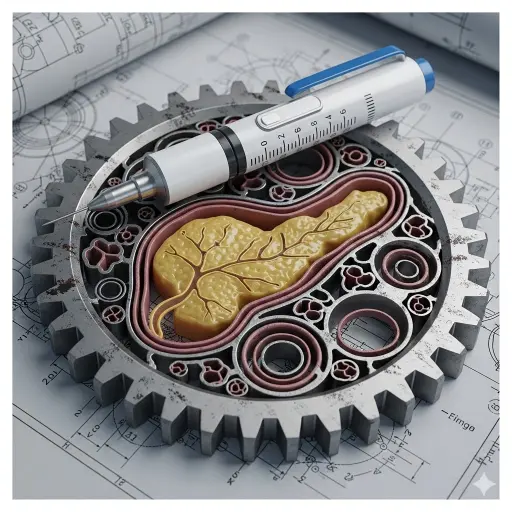
1. The Engineer’s Choice: Discipline Today or Surgery Tomorrow?
This reflection could start with science, but its urgency is born from personal experience. One day, returning to my ophthalmologist, I cheerfully commented that I was seeing better. His response was a shock: “That’s terrible news.”
He explained that a sudden “improvement” in vision can be an alarm. It could be the onset of cataracts or a sign of prediabetes, where excess sugar causes the lens to swell with water, altering the prescription. Tests confirmed prediabetes—a documented side effect of statin use. His final prescription wasn’t a new medicine, but an engineer’s advice: “Helder, eliminate sugar from your life.” I did.
This story illustrates the crossroads where many find themselves. The food industry, in a relentless pursuit of profit, has engineered addictive products, hijacking our pleasure centers. It’s an industry that profits from our idolatry of pleasure, which makes us sick. And then, another industry emerges, the pharmaceutical one, which sells us the “little pen” to manage the damage.
The central question is this: for the pre-diabetic who “loves a sweet treat” and trusts that technology will save them, the question isn’t about the side effects of a drug, but of the disease. Your pedicurist worries about your foot because she knows the result of neglect: neuropathy, non-healing wounds, amputation. She sees the tip of the iceberg of suffering that includes blindness (retinopathy), kidney failure (nephropathy), and impotence (erectile dysfunction).
If the real risk of losing a foot doesn’t scare us today, why would we worry about the side effects of a pen? If you can’t muster the self-control to “close your mouth,” the “little pen” can be a helpful tool. But if, even with it, you continue to turn a blind eye to reality, you’ll enter a double-risk scenario: the effects of diabetes and those of the medication.
2. The Engineering of the “Pen” and Its Real Risks
The new GLP-1/GIP receptor agonists are “efficiency managers” for an overworked insulin “factory.” They optimize production and create satiety. But this powerful tool has its risks. I personally know the case of a person with cardiac arrhythmia who, after participating in clinical trials for a “pen” with two agonists, developed “biliary sludge” and required surgery.
Reports from the FDA and a growing number of lawsuits in the United States confirm the risks:
- Stomach Paralysis (Gastroparesis): A serious and sometimes irreversible condition.
- Bowel Obstruction (Ileus): A warning the FDA has already added to the labels of some of these drugs.
- Worsening of Retinopathy: A very rapid drop in blood sugar can, paradoxically, worsen pre-existing vision problems.
- Other Risks: Pancreatitis, gallbladder problems, and the risk of thyroid tumors.
3. Dependence and Factory Failure
This brings us to the most important engineering question: while you still have insulin production, the pen helps. But when there’s no more insulin, is the pen still necessary?
The answer, from a biological engineering standpoint, is no. An “efficiency manager” is useless in a failed factory. GLP-1/GIP agonists work by “ordering” your already exhausted beta cells to produce insulin more intelligently. When those cells die after years of “overtime,” the patient becomes fully insulin-dependent. The “pen,” an expensive, lifelong management tool, no longer has a “factory” to manage. At this point, the T2D patient’s engineering problem becomes identical to that of a T1D patient.
4. The Bridge to the “T1D Wing”: The Engineering of Reconstruction
This is where our conversation becomes hopeful. The solution for a failed factory isn’t a better manager; it’s a new factory. And the “blueprint” for this new factory is being drawn in the labs that today focus on T1D, with technologies like VX-880 and VX-264.
Conclusion: The Engineer’s Toolbox
The future of diabetes treatment is not a single magic solution. The “pens” are revolutionary management tools. Cell therapy is the promise of a “complete factory overhaul.” But the most powerful tool in your toolbox is discipline. It is the act of stewardship of an engineer taking control of their own health, with prudence, knowledge, and a hope grounded not in magic promises, but in the wisdom that the best works are those that are well-cared for from the foundation up.
Related Readings
- VX-880: The Promise of Stem Cells
- VX-264: The Engineering of the ‘Invisible’ Cell
- Lantidra: The Therapy That Proved the Concept