



1. The Award-Winning Discovery: Peacemakers of Immunity
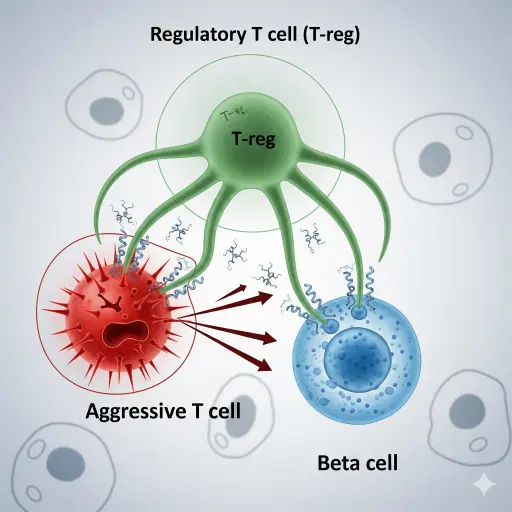
Type 1 Diabetes (T1D) is an autoimmune disease characterized by the destruction of insulin-producing beta cells by autoreactive T lymphocytes. The discovery that the body has active mechanisms to prevent this self-destruction was the focus of the 2025 Nobel Prize in Physiology or Medicine, awarded to Mary E. Brunkow, Fred Ramsdell, and Shimon Sakaguchi.
The laureates unraveled the mystery of peripheral immune tolerance:
- Regulatory T-Cells (T-regs): Identified by Sakaguchi, these cells are a class of T lymphocytes that function as peacemakers of the immune system. Their function is to suppress the activity of other T cells, preventing them from attacking the body’s healthy tissues.
- The FOXP3 Gene: Brunkow and Ramsdell identified the FOXP3 gene, the “master switch.” Mutations in this gene cause severe autoimmune diseases, proving its crucial role in the development and function of T-regs.
T1D is, essentially, a failure in this control system, where the imbalance between aggressor T cells and regulatory T-regs leads to a loss of tolerance.
2. The Third Path: Personalized Immune Modulation
The Nobel discoveries open a third path, complementary to the treatments we are already following:
| Strategy | Objective | Example in the Diabetes Dossier |
|---|---|---|
| Delaying the Disease | Slow down the aggression in Stage 2, preserving remaining beta cells. | Teplizumab. |
| Cell Replacement | Replace the lost beta cells with an unlimited source of stem cells. | The VX-880. |
| Cell Protection | Make the replacement cells ‘invisible’ to the patient’s immune system. | The VX-264 (hypoimmune cell). |
| Restoring Tolerance (Nobel) | Correct the immune system’s communication failure by reinforcing the natural ‘brake’. | Expanded T-reg Therapy (New Frontier). |
Immunotherapy with autologous T-regs (from the patient) is already being investigated in clinical trials for T1D. The therapy involves collecting the patient’s T-regs, expanding them (multiplying them) in the lab, and infusing them back. The objective of this intervention is to restore immune homeostasis and, thus, preserve the function of residual beta cells.
3. The Synergy: Cell Protection Meets System Re-education
The true potential of this discovery emerges when we unite T-reg Therapy with the Personal Bio-Insurance Thesis and the Invisible Cell (VX-264) technology.
- The VX-264 Challenge: The ‘Invisible Cell’ solves the rejection problem, but it does not correct the root cause of the patient’s autoimmune attack.
- The Dual-Action Solution: By combining them, we can create a dual-protection system:
| Component | Function | Advantage |
|---|---|---|
| Edited Beta Cell (VX-264) | Passive Protection (Genetic Shield) | Ensures the survival of the new implanted cells in the hostile environment. |
| Dose of Expanded T-regs | Active Protection (Immune Re-education) | Addresses the source of the disease, reinforcing the body’s immune balance and preventing future attacks on other cells. |
This convergence of basic science (Nobel) and advanced biotechnology (Vertex) points to a treatment that not only replaces what was lost but also repairs the failure that led to the disease, creating the possibility of a functional and lasting cure.
4. Hope for Other Autoimmune Diseases
The discovery of Peripheral Immune Tolerance is not limited to Type 1 Diabetes. The principle is universal.
- Rheumatoid Arthritis and Lupus: As classic autoimmune diseases, reinforcing Regulatory T-Cells is a direct and immensely promising treatment strategy to calm the inflammation and chronic attack on joints or other organs.
- Amyotrophic Lateral Sclerosis (ALS): Although ALS is primarily neurodegenerative, science has shown that neuro-inflammation plays a role in the disease’s progression. Therapy with dysfunctional or low-numbered T-regs is an active line of research that offers hope for slowing the devastating progression of this disease by enhancing the modulation of inflammation in the nervous system.
The knowledge from the 2025 Nobel is the map. Now, the scientific community and biotech companies have the objective of translating this fundamental science into real therapies for millions of people.
Related Readings
- Stopping the Internal War: The Promise of Immunotherapy
- VX-264: The Engineering of the ‘Invisible’ Cell
- The Personal Bio-Insurance: A Vision for the Future
- The Weapon and the Trigger: Understanding the Origins of T1D