



The other day, we were reflecting on one of those questions that seem to put science and faith on opposite paths: the age of humanity.
Archaeology reveals fossils and tools from hundreds of thousands of years ago. Genetics confirms a long human history. And the Bible presents Adam in a much more recent scenario. The tension appears when we try to forcefully fit one narrative into the other.
But perhaps this collision exists only because we are asking the Bible a question it is not trying to answer. And what if the focus of Genesis is not the biology of all beings, but the spiritual origin of a specific lineage?
The Bible is truth, but God is logical. Scripture itself is full of “other peoples” who are simply “there,” with no detailed origin story. When Abraham faces famine, he “goes down to Egypt,” an already structured, ancient, and complex civilization. The Bible does not stop to explain where the Egyptians came from, because that is not the focus.
With this in mind, the creation of Adam gains new light. The text says God formed man from dust, but did something unprecedented:
“Then the Lord God formed a man from the dust of the ground and breathed into his nostrils the breath of life, and the man became a living being [living soul].”
(Genesis, Chapter 2, Verse 7)
Here, the humanity of the soul is born. Before, there was biological humanity — living beings, hunters, natural human groups. With Adam, relational humanity is born. The breath is not just biological life; it is spiritual consciousness, vocation, and the capacity to walk with God.
This is why, when naming the animals, Adam feels loneliness. He saw living beings everywhere, perhaps even other biological “humans,” but found no one who shared this new dimension of “living soul.”
To solve this loneliness, God does not create another creature from the dust. He does something theologically profound:
“So the Lord God caused the man to fall into a deep sleep… he took one of the man’s ribs… and made a woman.”
(Genesis, Chapter 2, Verses 21 and 22)
Eve doesn’t come from outside; she comes from within. She is born from the opening of Adam’s side to show she shares the same spiritual nature. The lineage of communion is not biology; it is essence.
But soon we see the rupture. The “living soul” chooses autonomy. What was once natural—the walk with God in the cool of the day—becomes a cause for fear. Man hides. Communion is broken.
And this is where humanity suffers its first great internal fracture, represented by the two paths of Cain and Abel (and later Seth).
Communion, in the beginning, was the default state. It was easy. The image we have is of a walk in the cool of the day.
“Then the man and his wife heard the sound of the Lord God as he was walking in the garden in the cool of the day…”
(Genesis, Chapter 3, Verse 8)
God is the one who took the initiative. Intimacy was not something to be “sought” or “earned” by Adam; it was given, offered freely by God. Adam’s purpose was simply to be present when God came to talk.
But Adam chose autonomy. And the first consequence is not physical death; it is relational death.
“…I was afraid because I was naked; so I hid.”
(Genesis, Chapter 3, Verse 10)
From now on, the intimacy that was once given (the walk) would have to be sought (the cry).
Humanity divides into two mindsets: that of Cain (autonomy, which builds) and that of Seth (dependence, which cries out).
Cain’s lineage, by building a city for protection, becomes “inhumane” in its violence, culminating in Lamech.
“…for I have killed a man for wounding me, a young man for injuring me.”
(Genesis, Chapter 4, Verse 23)
On the other side, Seth is born. And the mark of this lineage is the opposite of Cain’s city:
“To Seth also a son was born… At that time people began to call on the name of the Lord.”
(Genesis, Chapter 4, Verse 26)
Cain’s lineage builds. Seth’s lineage calls out.
But the problem of humanity “in Adam” was deeper than a choice of dwelling. It was a problem of nature.
Even Seth, in calling out, was still stained by the fall. His prayer was a plea for rescue, but it did not carry the power of resurrection. The lineage of calling out was not sufficient to restore full life. The failure of both approaches—that of autonomy (the city) and that of religion (calling out)—points to the necessity of something that did not come from the dust, but from heaven. The Last Adam was needed.
“For as in Adam all die, so in Christ all will be made alive.”
(First Corinthians, Chapter 15, Verse 22)
Jesus did not come to fix Adam; He came to inaugurate a new lineage.
“The first man Adam became a living being; the last Adam, a life-giving spirit.”
(First Corinthians, Chapter 15, Verse 45)
In Adam, we received the “breath of life” (living soul). In Christ, we receive the “Spirit who gives life.”
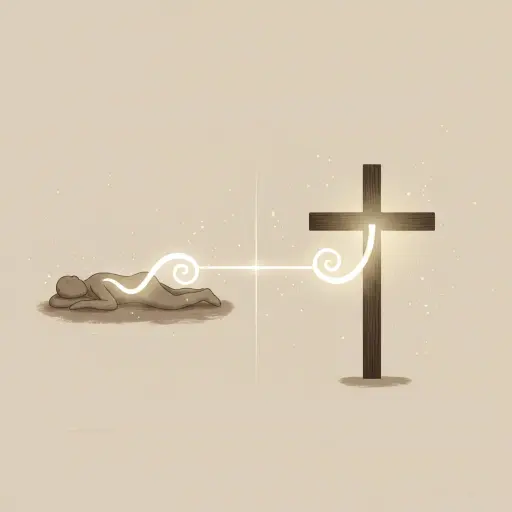
And God’s symmetry is perfect. Remember: the humanity of the soul was born from the open side of a sleeping Adam. Now, look at the Cross.
“…one of the soldiers pierced Jesus’ side with a spear, bringing a sudden flow of blood and water.”
(John, Chapter 19, Verse 34)
From the open side of the Last Adam, the Church was born, the new humanity. No longer based only on the “breath” that makes us live, but on the “blood and water” that makes us live again.
In Cain, we build to hide. In Seth, we call out from afar. In Christ, we are brought near, made a “new creation,” restored to eternal intimacy.
The Bible is not a biology book. It is the map of our spiritual vocation—from “living soul” to “life-giving spirit.”