
The other day, I read a phrase on a bakery wall that seemed as beautiful as it was dangerous.
“Cages are where certainties dwell. We are like this: we dream of flight, but we fear the height. To fly, you need courage to face the terror of the void, because flight only happens in the void. The void is the space of freedom, the absence of certainties. But this is what we fear: not having certainties. That’s why we trade flight for cages.”
For a moment, I felt a spark of inspiration. It seemed profound, liberating. But after a few seconds, something inside me grew restless. What exactly does this phrase, written by Rubens Alves, mean? Is it inviting me to live with more faith, or just to take impulsive risks? If I understood correctly, it’s saying that if I want to fly, I must abandon my certainties. That only when I leap into the void will I discover what freedom is. But what if I jump — and can’t fly? Will God come like the eagle and hold me, as Isaiah 40:31 promises? Or will I just be repeating the old story of someone who tried to be the master of their own destiny?
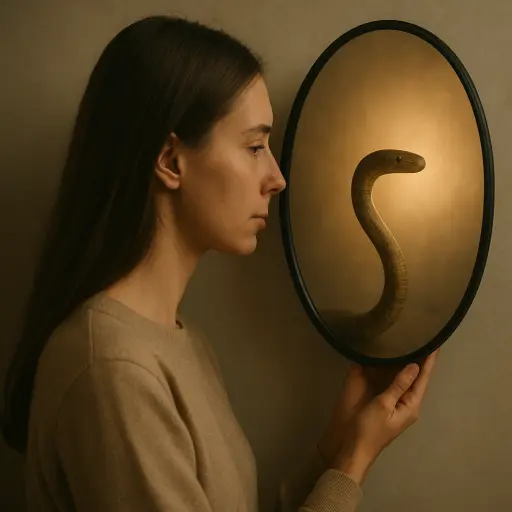
These questions took me far. I began to realize that behind many beautiful phrases, there is an ancient voice, disguised as wisdom. A voice that seems to invite courage, but in reality, invites independence. And suddenly, I understood: it’s the same voice that spoke in Eden.
The Serpent’s Voice Keeps Speaking
The serpent’s voice continues to speak. “You surely will not die,” the serpent said.
“For God knows that when you eat of it your eyes will be opened, and you will be like God.” (Genesis 3:4–5)
See? It didn’t offer destruction, it offered autonomy. It didn’t say “abandon God,” it said “don’t need Him anymore.” It was an invitation to freedom — but without the Creator. And since then, that voice has never been silent. Today, it no longer comes as a serpent among trees. It comes on screens, in self-help books, in speeches packaged with music and light. It speaks with smiles and microphones: “You already are.” “You already have.” “Just claim it.” And the world applauds, because this voice massages the ego — but steals the soul.
How many times have I heard: “Have faith in yourself!” And every time I hear it, something bothers me. Faith in me? But who am I to sustain my own faith? Faith in oneself is like building a house on the sand — the first rain is enough for everything to collapse. The apostle Paul wrote:
“If anyone thinks they are something when they are nothing, they deceive themselves.” (Galatians 6:3)
True faith doesn’t start in the mirror, but at the foot of the cross. It’s not an inner power; it’s a surrender. It’s saying: “Lord, without You I can do nothing.” (John 15:5) While the serpent whispers “you can do anything,” the Spirit whispers “I can do all things through Christ who strengthens me.” (Philippians 4:13).
The Leap into the Void and the Walk of Faith
The modern serpent loves the “leap into the void.” It says: “Be brave, jump, trust your heart!” But God never told anyone to jump. God tells us to walk.
“Enoch walked faithfully with God; then he was no more, because God took him away.” (Genesis 5:24) “Walk before me faithfully and be blameless.” (Genesis 17:1)
The divine call is not for the spectacle of the jump, but for the constancy of the step. The flight of faith is not born of impulse, but of waiting on the Lord. Isaiah said:
“But those who hope in the Lord will renew their strength. They will soar on wings like eagles.” (Isaiah 40:31)
See the difference? The serpent says “fly alone.” God says “wait, and I will make you fly.” The jump of self-confidence ends on the floor of pride. But the flight of the Spirit begins in the silence of waiting.
Has the Pulpit Become a Stage?
The other day, I heard a preacher repeat the word “purpose” seven times in two minutes. And I kept wondering: did I understand the purpose? Is God’s purpose really “to succeed in life”? To be first? To be seen? Or is the purpose to bear fruit, as Jesus said?
“This is to my Father’s glory, that you bear much fruit, showing yourselves to be my disciples.” (John 15:8)
Bearing fruit is not winning. Bearing fruit is serving, it is feeding others with what God grows in us. The world’s success is shine, but God’s fruit is sustenance. And you don’t harvest fruit without roots, nor roots without soil. Jesus never preached “climb higher” — He preached “come down and serve.” Whoever wants to be the greatest must be the servant. (Mark 9:35) But the serpent, disguised as a coach, keeps saying: “You were born for the top.” And its top is the same mountain of pride where Lucifer wanted to ascend.
The Subtlety of Deception
It is curious how error rarely looks like error. It comes in the guise of good. The serpent didn’t offer poison — it offered wisdom. The modern preacher doesn’t offer sin — he offers power. But all power without dependence is rebellion. The first fall of man was not due to weakness; it was due to self-affirmation. Eve did not sin because she doubted herself; she sinned because she believed too much in herself. And this is still the root of sin: wanting to be sufficient, independent, master of one’s own destiny. God, however, works in the opposite direction. He does not strengthen pride; He breaks it. He doesn’t inflate the ego; He molds it until the Spirit fits.
“The Lord is my shepherd; I lack nothing.” (Psalm 23:1)
This phrase is not a cry of self-sufficiency, but of dependence. I will lack nothing — because the Lord is.
The Deception of “Result-Oriented Faith”
We live in the era of “faith that works.” Prayers become methods, promises become slogans, and the cross is exchanged for the stage. Many seek God for what He can give, not for who He is. But the Gospel is not a tool for conquest — it is a path of surrender. When Jesus multiplied the loaves, the crowds followed Him. But when He spoke about eating His flesh and drinking His blood — about communion and sacrifice — many left. (John 6:66) Because man wants a God who solves problems, not a God who governs. But God is not a genie in a lamp. He is Father, King, and Lord. Faith that seeks results loses its meaning when the result doesn’t come. But the faith that seeks God remains even in the wilderness.
“Though the fig tree does not bud… yet I will rejoice in the Lord.” (Habakkuk 3:17–18)
This is the faith the serpent hates — the faith that does not bargain.
Peter, the Wind, and the Focus
Peter walked on water. But why did he start sinking? The wind didn’t change. The sea didn’t change. What changed was his focus. As long as he looked at Jesus, he walked. When he looked at the wind, he sank. The same thing happens to me. As long as my eyes are on Christ, the impossible becomes possible. But when I shift my gaze to fear — or to pride — I sink instantly. The serpent wants me to look at myself. God wants me to look at Christ. Because the strength comes from Him, not from me.
“Fixing our eyes on Jesus, the pioneer and perfecter of faith.” (Hebrews 12:2)
The Spirit is the Wind and the Wings
I return to that initial phrase: “Cages are where certainties dwell.” Now I understand it differently. It’s not human certainties that trap me, but certainties without God. The Spirit is the wind that liberates — not for the void, but for heaven. Flying, in the Kingdom, is not leaping out of impulse. It is being carried by the wind of the Spirit. It is not human courage; it is divine submission. It is not the shout of “I can,” it is the whisper of “Your will be done.” The Spirit is the wind that moves. And when He blows, even the bird without wings begins to ascend. Because flight does not depend on human impulse, but on the breath of God.
“The wind blows wherever it pleases… So it is with everyone born of the Spirit.” (John 3:8)
The Freedom of Dependence
The more the world talks about freedom, the more man becomes enslaved. Enslaved to his own image, his performance, his certainties. But true freedom lies in dependence. The free man is one who doesn’t need to prove anything — because he knows in whom he has believed.
“Then you will know the truth, and the truth will set you free.” (John 8:32)
The serpent offers wings without wind. God offers wind even to those without wings. And when the Spirit blows, the cages open, fear yields, and the flight begins — not because I threw myself into the void, but because I trusted the wind. Faith is not the leap in the dark; it is the step in the direction of the voice that calls me. And when I hear that voice, it doesn’t say “you already are,” or “you already have.” It only says: “Follow me.”