



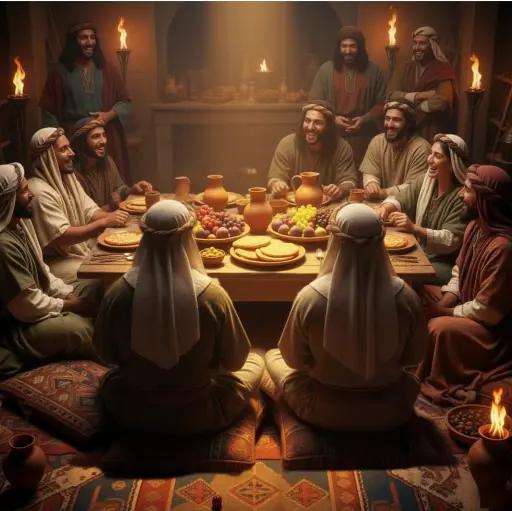
The life of faith is a journey marked by feasts and wildernesses. In the first essay, we understood that fasting is born of longing; in the second, that it transforms into an intimate gathering with the Spirit. Now, this essay takes us to the core of the issue: why, after all, do we fast? And what does the figure of the Bridegroom teach us about this practice?
We need to return to the scene that scandalized the religious people of the time. Jesus was at the table in a tax collector’s house, a man who represented impurity and social dishonor. There was laughter, bread, and wine; there was a feast. The religious people, who strictly followed the rituals, watched from a distance, bothered. They fasted, and John’s disciples fasted too. But Jesus’ disciples ate with Him, and this joy was unacceptable.
It was then that the question came, loaded with judgment: “Why do your disciples not fast like us?”
Jesus’ answer was not an argument; it was a revelation that rewrote the meaning of fasting forever. He looked at the heart of the matter, which was not in the food or the rule, but in the Presence.
The Lesson of the Wedding Feast
Jesus responded with the metaphor that defines the relationship between Him and His people: the figure of the bridegroom and the wedding guests. “Can the guests of the bridegroom fast while the bridegroom is with them? Days will come when the bridegroom is taken away from them, and then they will fast.” (Matthew 9:15).
The lesson is monumental. Fasting, for Jesus, is not a way to prove holiness, but a language of longing. While the Bridegroom was physically present, the atmosphere was one of celebration. The Kingdom had arrived; it was a time of joy. Fasting would have been a contradiction, a liturgical inconsistency.
But He prophesied His absence. “Days will come when the bridegroom is taken away from them.” This absence, caused by the cross and ascension, inaugurates the true fast of the New Testament. Fasting, from then on, is driven by waiting, by yearning, by the holy longing for His manifest Presence. We do not fast to convince God to return; we fast because the heart misses His Presence, and yearns for His return.
The Altar Instead of the Sugar
We observe the difference in motivation. The Pharisees fasted to draw attention; the disciples, because they missed Him. There is a huge difference between the sacrifice that wants to be seen and the silence that misses God.
He who fasts out of longing does not count the days; he counts the distances. He does not seek merit; he seeks reunion. Jesus did not condemn fasting, but restored its deepest meaning. The body can abstain from food, but the spirit cannot live without communion. The true fast is one in which the soul rejects noise, excess, and haste, transforming the table into an altar and the bread into a symbol of friendship with the Bridegroom.
Sitting at the table with Jesus was — and still is — an act of grace. He did not expect the tax collectors to perform ritual fasts or become saints before approaching. He went to them, ate with them, looked into their eyes. The table was not a prize for the righteous; it was the starting point for transformation. And whoever sits at the table with Christ discovers that holiness begins with affection: the love that accepts, the silence that heals, the presence that transforms.
The Bride’s Fast and the Final Wait
The depth of this metaphor requires a crucial biblical distinction. The Scriptures tell us about different relationships with God. Israel is His Wife, the nation chosen and bound to Him by covenant, while the Church, the body of Christ, is the Bride preparing for the final banquet.
We, the Bride, fast today because we are in a period of waiting. The Bridegroom was “taken away” (ascended to the Father), and we await His return for the Wedding Feast. This fast has nothing to do with politics or the mistakes of the Wife (Israel) or the Bride (the Church). Our task, as the Bride, is not to judge, criticize, or speak ill of those in the field, but to prepare ourselves with oil in our lamps (Matthew 25).
Our energy cannot be spent on earthly issues that distance us from the Bridegroom’s affection. When we focus on criticism, we lose the cadence of longing. Fasting must be an act of love that realigns us with the heart of Christ. It must be the discipline of choosing to love and wait, rather than judging and accusing. We cannot be the Bride who is so busy criticizing others that she forgets to polish her own wedding garment.
The Non-Negotiable Essence
There are times to fast and times to eat. But in all of them, the center is non-negotiable: the Presence of the Bridegroom. When He is present, everything is a feast; life is full. When He is absent (in our perception, due to sin or distraction), longing is born, and the heart fasts.
This longing is the fuel that drives the communion of the four, which we discussed in the previous essay: the Father who hears, the Son who intercedes, the Spirit who prays, and the man who misses Him. The disciples’ fast was not empty; it was waiting.
It is the final act of love that the Bride shows by saying: “I exchange the comfort of the earth, I exchange immediate satisfaction, for the hope of seeing You again.” This is our fast. It is an active wait, full of love, until the Bridegroom returns and the banquet begins again — without tears, without haste, without end.
Back to the beginning of the Trilogy: Intimacy with God is Enough Original message that inspired this reflection: ‘Mais Sede do Senhor’ – Pr. Ernesto Ferreira Jr.