



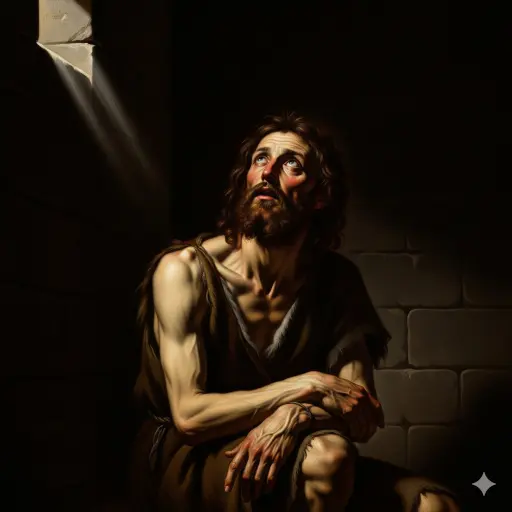
The Cold Cell and the Echoing Question
There are moments when even the most faithful servants become confused. John the Baptist, the fiery prophet who prepared the way for the Messiah, was imprisoned. His voice, which had thundered in the desert announcing judgment, was now silenced by the stone walls of the fortress of Machaerus. According to the historian Josephus, it was there that Herod Antipas held him, just meters from the hall where the court’s feasts took place. While the elite danced, the prophet languished.
It was in this setting of isolation that John, hearing of Christ’s works, sent his disciples with a question that, at first glance, is shocking:
“Are you the one who is to come, or should we expect someone else?” (Matthew 11:3)
The question sounds strange coming from the man who saw the heavens open. But this is not disbelief. It is the spiritual tension of one who has dedicated his life to a calling and, at the final moment, reality does not match the expectation.
The Unexpected Messiah: Fire vs. Mercy
John expected a Messiah who would come with “axe and fire” (Matthew 3:10-12). He expected a liberator who would confront Herod’s corrupt power. But what did he hear from his prison?
“The blind receive sight, the lame walk, those who have leprosy are cleansed, the deaf hear, the dead are raised, and the good news is proclaimed to the poor.” (Matthew 11:5)
He expected fire, but he was seeing mercy and kindness. His doubt was not about Jesus’s identity, but about God’s method. “Why is the Kingdom coming so gently, if the axe was already at the root?”.
Jesus’s Answer: A Report of Evidence
Jesus was not offended. He did not send a reprimand. He sent a “report of evidence,” quoting the prophecies of Isaiah (35:5-6 and 61:1). It was as if He were saying, “John, the blueprint is being followed to the letter. The Kingdom is happening. It’s just not coming in the order you imagined. Grace came before judgment.”
And then, He adds the phrase that is the heart of our reflection:
“Blessed is anyone who does not take offense at me.” (Matthew 11:6)
The Two-Edged Blade: The Danger of “Stumbling”
The word for “take offense,” in the original Greek skandalízō, is much stronger than a simple “stumble.” It comes from skándalon, the trigger of a trap. In a spiritual sense, it means to be led to doubt, to be offended by God, to lose faith because He did not act as we expected.
The greatest stumble is to expect God to act in our image.
It is a two-edged blade. The first edge cuts inward: the danger of our personal disappointment turning into murmuring and distancing us from God. The second edge cuts outward: our murmuring can become a “stumbling block” for the “little ones in the faith” (Matthew 18:6), those who, seeing our confusion, may themselves begin to doubt.
The Final Contrast: Purpose in Pain
John dedicated his life to the call and did not understand the prison. His ministry was brief and his death, swift. He did not see the cross. Jesus, on the other hand, understood the cross, and His path was long, filled with pain and humiliation. But both fulfilled their purpose. Sometimes, God does not explain the “why.” He just asks us to remain faithful in the meantime.
An Invitation to Reflection
Perhaps today you are in your own “prison.” The temptation to murmur is real. But Jesus’s answer to John echoes for us: “Blessed is the one who does not lose faith because of what they do not understand in Me.”
So, when you go to chat with God, perhaps the request to Jesus can be not to change the circumstances, but to give you the eyes of spiritual knowledge:
- To see your path on earth, even if it’s one step at a time.
- To discern what God is doing for you, even if it is just the gift of a few more minutes of life today.
- And to be content with the essential: salvation, the presence of the Spirit, and all that Jesus has already done for you on the cross.
Because the greatest miracle is not God changing our situation, but changing our hearts within it.
This reflection is part of the ‘Pills of Wisdom — Deepening the Journey’ series. To deepen your understanding, explore our {{%< link-interno “/en/manuals/fundamentos-da-alma/discipulado/” “Discipleship Manuals” >%}}.