



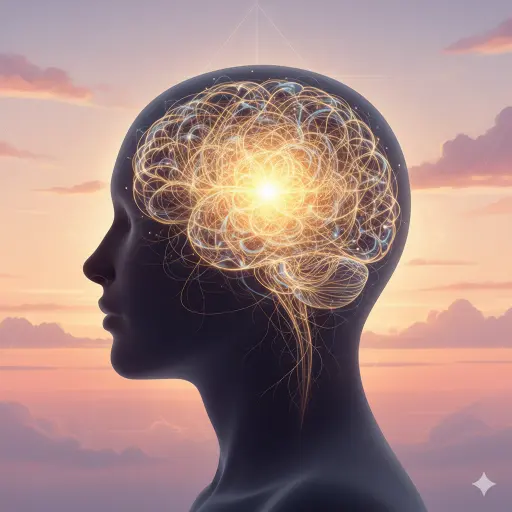
A few days ago, I saw a curious story — the so-called “Helen Code.” It was one of those messages promising to awaken our best selves, but something about it made me stop and reflect. Not because of the video’s aesthetics, nor the emotion of the words, but because, behind that simplicity, there was a profound truth: the human brain truly seems programmed to cooperate with what we decide to believe.
I then remembered an old interview with a neurosurgeon from USP. He explained that the subconscious is like a silent servant: when we define an objective with clarity, it begins to reorganize our thoughts, emotions, and even small habits to bring us closer to it.
He said: “Your brain creates automatic pathways. It selects what you perceive, remember, and desire, according to the intention you feed it.”¹
And, as he spoke, something occurred to me: is it just the brain that does this? Or did God create us exactly this way, so that our mind and soul might cooperate with the plans from Above?
1. When Science Meets the Creator
The Bible said something similar long before neuroscience textbooks:
“For as he thinks in his heart, so is he.” (Proverbs 23:7)
This verse speaks of an internal law: thought shapes the being. Not just behavior, but the very course of life. When we feed an idea with faith, it’s not just the brain that works — the Spirit of God begins to act within the field of real possibilities.
Neuroscientists call this phenomenon the Reticular Activating System (RAS). It is a network of neurons in the brainstem that filters millions of stimuli per second, choosing what is relevant according to the mind’s focus.²
In other words, if you start the day determined to bless people, the brain begins to notice opportunities to do so. If you decide to complain, it begins to see reasons to lament.
Now see how this echoes in the Scriptures:
“Do not conform to the pattern of this world, but be transformed by the renewing of your mind. Then you will be able to test and approve what God’s will is—his good, pleasing and perfect will.” (Romans 12:2)
Paul wasn’t just talking about “positive thinking,” but about reprogramming the mind according to the values of the Kingdom, allowing the brain and heart to align with what God wants to do in us.
2. The Helen Code and the Power of Inner Focus
The “Helen Code” says, in short, “you need to tell the universe what you want, and the universe will reorganize to bring it to you.”
But here’s the point: the universe has no will of its own — the one who reorganizes is you. God created us with this capability.
When we pray, declare, write, meditate — we are not moving the heavens by magic; we are clearing the way for the Holy Spirit to act on a willing heart.
“Delight yourself in the Lord, and he will give you the desires of your heart.” (Psalm 37:4)
The verse doesn’t say God fulfills any whim. It says He satisfies the desires of the heart that already delights in Him. When we align with the Creator, even our desires become righteous, and the subconscious begins to act in harmony with the Spirit.
Then, our mind conspires with heaven.
3. Think, Meditate, Live
I often go to sleep thinking about a Bible verse. It’s not superstition. It’s practice.
Neuroscience shows that the brain continues to process information during sleep, consolidating memories and emotions.³ When I lie down meditating on the Word, I am sowing clean thoughts so that the Spirit can teach me even as I sleep.
“Blessed is the one who… meditates on his law day and night.” (Psalm 1:2)
Note the detail: day and night. Constancy is what engraves the inner direction into the deepest structures of the mind. When I wake up, I notice the day’s choices seem clearer, as if an invisible compass was calibrated during sleep.
4. What Do You Plant in Yourself?
The Bible speaks of sowing and reaping, but few understand this also applies to the mental field:
“A man reaps what he sows.” (Galatians 6:7)
Every repeated thought is a seed. Every word spoken in faith is water. And the subconscious is like the soil that sprouts what was planted — it doesn’t distinguish if it’s good or bad, it just multiplies.
That is why God warns us to guard our thoughts, not as moralism, but as spiritual hygiene:
“Above all else, guard your heart, for everything you do flows from it.” (Proverbs 4:23)
Neuroscience confirms: repeated thoughts strengthen synaptic connections. It’s the principle of neuroplasticity.⁴ You become what you repeat, and you repeat what you believe.
5. Between Faith and Biology
If the subconscious conspires with what we believe, then faith is the biological trigger for the miracle. Faith activates brain networks linked to hope, motivation, and pleasure. This doesn’t diminish the spiritual — it just shows that God wrote His signature even in our neurons.
“Now faith is confidence in what we hope for and assurance about what we do not see.” (Hebrews 11:1)
When a Christian prays and visualizes an answer, the brain releases dopamine, the motivation hormone.⁵ This impels us to act coherently with what we prayed for — and that is how the invisible begins to become visible.
The body, mind, and spirit enter into an alliance.
6. When the Conspiracy is Holy
So, yes — there is a conspiracy. But it is not cosmic or mystical. It is divine and intimate.
When you place yourself at the center of God’s will, your brain conspires for good, your subconscious works to maintain the course, and Heaven itself collaborates with those who love the Lord.
“In their hearts humans plan their course, but the Lord establishes their steps.” (Proverbs 16:9)
The brain may be the tool, but the Spirit is the guide.
7. Conclusion: The Wrong Address
The so-called “Helen Code” just gets the address wrong.
It is not the universe that conspires. It is God who inspires, and it is the human mind that executes — if it is willing. Our subconscious is part of the wisdom of creation. It was made to cooperate with faith, not to replace it.
“Commit your way to the Lord; trust in him and he will do this.” (Psalm 37:5)
Meditating, thinking, and acting are not separate things. They are steps on the same ladder: the ladder that connects the mind to the heart, and the heart to heaven.
🔗 Scientific References
¹ Dr. Guilherme Sciascia do Olival (Neurologist/USP) – Context of Neuromotivation and cerebral focus. ² Bear, M. F. et al. Neuroscience: Exploring the Brain, 4th ed., Wolters Kluwer, 2020 – Ch. 10: “Reticular Formation”. ³ Walker, M. Why We Sleep, Scribner, 2017 – Sections on memory and emotion consolidation. ⁴ Doidge, N. The Brain That Changes Itself, Penguin, 2007 – Ch. 2: “Neuroplasticity and Repetition”. ⁵ Kapogiannis, D. et al. “Neural correlates of religious belief.” PNAS, 2009.