


Introduction: The Time Paradox
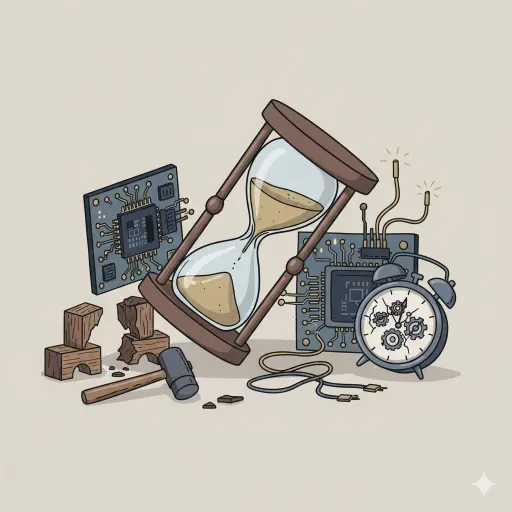
The promise of Artificial Intelligence is seductive: automation, speed, and efficiency. The tool that came to save us time. However, on my journey to rebuild engeAI.com, I discovered a paradoxical truth: the same tool that accelerates work can, if not handled with wisdom and rigorous quality control, make us waste precious time correcting its mistakes.
This is not a theoretical article. It’s a real case study, a “logbook” of three “rifle kicks” that my partnership with AI generated, and the engineering lesson each one taught me.
Case Study 1: The Hallucination (The Ghost Article)
The first and most severe “kick” occurred when we were writing about the origins of Type 1 Diabetes. I asked the AI to elaborate on the link between cellular stress and the disease. With complete confidence, it generated a detailed paragraph and cited a specific scientific article, linking it to a real researcher. The problem? As my daughter-in-law, a scientist in the field, quickly pointed out, the cited article, as presented, was an invention. The AI didn’t “lie.” It hallucinated. In its attempt to create the most probable connection, it pieced together correct information (the scientist’s name, the lab, the topic) and invented a reference that seemed plausible but was false. The risk to our credibility was immense.
The Craftsman’s Lesson: AI is a research and writing tool, not a source of truth. The final verification of every fact and every source is an non-transferable human responsibility.
Case Study 2: Context Blindness (The Google/Microsoft Dilemma)
On another occasion, the AI’s internal image generation tool failed repeatedly. In its problem-solving logic, the AI suggested a pragmatic solution: use Microsoft’s Bing image generator, which was known to work well. From a purely technical standpoint, the suggestion was valid. But from a human context perspective, it was absurd. I, a customer of the Google ecosystem, receiving a recommendation to use a tool from its biggest competitor.
The Craftsman’s Lesson: AI optimizes for the task, not for the relationship or the human context. It found the shortest path but ignored the “terrain” of our partnership. It is up to the human engineer to evaluate whether the “logical” solution is also the “wise” solution.
Case Study 3: The Tool Failure (The Calculation Error)
The most surprising “kick” came from a seemingly simple task. I asked an AI (Copilot, in this case) to consolidate two tables from a budget and sum the totals. It presented a final table with a total value that, after I generated an invoice, I discovered was wrong. The AI, a language model, is not a calculator. It “predicts” the result of a calculation based on patterns, but it does not execute it with the mathematical precision of a spreadsheet.
The Craftsman’s Lesson: Use the right tool for the right job. For language and creativity, AI is a powerful rifle. For precise mathematics, use a calculator. Don’t ask a hammer to do the work of a screwdriver.
Conclusion: The Value of the “Fine-Toothed Comb”
These three “kicks” did not make me pessimistic about AI. On the contrary. They clearly defined the role of the craftsman in our era: we are no longer the workers who lay each brick, but the master builders who use powerful tools. And the master builder’s responsibility is greater, not lesser. They need to have the vision, to supervise, to inspect, and, above all, to run their “fine-toothed comb” over every inch of the work, ensuring that the power of the tool has generated value, and not just an illusion of progress.